Are Political Donations Tax Deductible? US, India and UK Rules
Political donations are not tax deductible in the US or UK, but India allows a deduction for non-cash gifts to registered parties. What counts, what doesn't, and why.
On this page
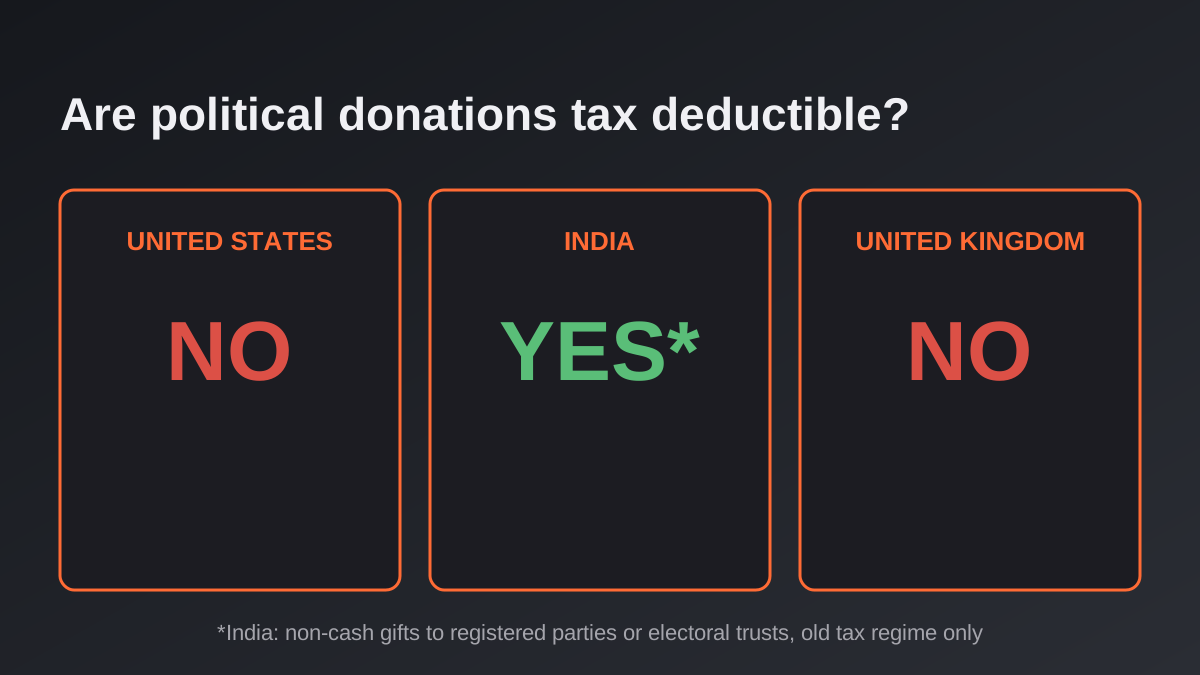
The short answer: in the United States, no. The IRS does not allow a deduction for money given to candidates, campaign committees, political parties or political action committees, and that applies to businesses as well as individuals. In the United Kingdom there is no income tax relief either, and Gift Aid does not apply to parties, although gifts to qualifying parties are exempt from Inheritance Tax. India is the exception: a contribution to a registered political party or an electoral trust is deductible, but only if it is not paid in cash and only if you file under the old tax regime.
Many donors assume a political donation works like a gift to charity. It does not, and the reasons say a lot about how each country tries to keep political money visible. Below: the rules country by country, the grey areas people get wrong, and what to keep as proof if you do claim a deduction.
This is a general explainer, not tax advice. Tax rules change, so check the official sources listed at the end, or a qualified adviser, before you file.
Quick comparison
| Country | Deductible for individuals? | Key condition | Where the rule lives |
|---|---|---|---|
| United States | No | Covers candidates, campaign committees, parties, PACs and fundraising dinners | IRS Publications 529 and 526 |
| India | Yes, old regime only | Non-cash payment to a party registered under section 29A of the Representation of the People Act, or to an electoral trust | Section 137, Income-tax Act 2025 (formerly section 80GGC) |
| United Kingdom | No income tax relief | Gift Aid is for charities and amateur sports clubs; gifts to qualifying parties are free of Inheritance Tax | GOV.UK and HMRC Inheritance Tax manual |
United States: political contributions are not deductible
IRS Publication 529 is blunt: "You can't deduct contributions made to a political candidate, a campaign committee, or a newsletter fund." It adds that advertisements in convention bulletins and admission to dinners or programs that benefit a political party or candidate are not deductible either. Publication 526, the IRS guide to charitable giving, says the same thing from the other side: political organizations and candidates are on its list of organizations you cannot deduct contributions to.
That rule closes the doors people most often try:
- Party committees and PACs. Giving to a national or state party, or to a political action committee, is a political contribution, not a charitable one.
- Super PACs and other "527" groups. These are political organizations taxed under section 527 of the Internal Revenue Code. Donations to them are not deductible, however large.
- Fundraising tickets. The whole price of a campaign dinner or gala ticket is non-deductible, including the part that paid for the meal.
- Business donations. Section 162(e) of the Internal Revenue Code bars business deductions for amounts spent participating or intervening in a political campaign, and for most lobbying. A company cannot book a campaign cheque as marketing.
- Trade-association dues. When an industry association spends part of its members' dues on lobbying or political activity, that share is not deductible as a business expense. Associations generally tell members what percentage of their dues falls into that bucket.
The 501(c)(3) and 501(c)(4) trap
Gifts to a 501(c)(3) charity are deductible if you itemise, and that is exactly why those charities are, in the IRS's words, "absolutely prohibited" from participating in any political campaign for or against a candidate. They may run genuinely non-partisan voter education and registration drives, but they cannot campaign. Social welfare groups organised under 501(c)(4) can do some political work as long as it is not their primary activity, and gifts to them are generally not deductible as charitable contributions.
So if a fundraising email promises that your gift is "tax-deductible" and also that it will help elect or defeat someone, treat that as a warning sign. Either the gift is going to a charity that is not supposed to campaign, or the tax claim is wrong.
State refunds and credits
A handful of US states have, at various times, offered small refunds or credits for contributions to state candidates or parties. These are separate state programmes with low caps, they have no effect on your federal return, and several have been suspended or ended. Check your state revenue department's guidance for the current year before counting on one.
India: a deduction, as long as you skip cash
India takes the opposite approach and uses the tax code to pull political funding into the banking system. Under the Income-tax Act, 1961, individuals and most other taxpayers claimed the deduction under section 80GGC, while companies used section 80GGB. The Income-tax Act, 2025, which applies from 1 April 2026, carries the rule forward. Section 137 allows a deduction for "the amount contributed... other than by way of cash, during a tax year to a political party registered under section 29A of the Representation of the People Act, 1951... or an electoral trust." Indian companies have a separate provision, section 136.
The conditions that matter in practice:
- No cash, at any amount. A contribution paid in cash gets no deduction, even a small one. Pay by bank transfer, UPI, cheque, card or demand draft.
- Registered parties and electoral trusts only. A payment to an individual candidate, or to an unregistered group, does not qualify.
- Old regime only. The new tax regime, which has been the default since 2023-24, does not allow this deduction. If you file under the new regime, a political donation brings no tax benefit.
- It cannot exceed your income. The deduction comes off your gross total income. It can bring your taxable income down, but it cannot create a loss.
Keep the party's official receipt, which should show the party's name, PAN and the mode of payment, along with the matching bank record. These are the documents an assessing officer will ask for.
Why scrutiny is rising
A deduction that can wipe out a large slice of taxable income attracts abuse. The Election Commission has delisted or flagged hundreds of registered but inactive parties in recent years for failing to contest elections or file reports, and the Income Tax Department has questioned deductions claimed for donations to such parties. A deduction backed by a donation that was quietly returned is not a deduction. It can be reversed with interest and penalties.
The disclosure side matters too. Parties must report contributions above ₹20,000 to the Election Commission. The electoral bond scheme, which let donors give anonymously through the State Bank of India, was struck down by the Supreme Court on 15 February 2024 in Association for Democratic Reforms v. Union of India, and the bond data was later published. Our explainer on hidden influence networks in political funding covers why that kind of transparency is hard to achieve.
United Kingdom: no income tax relief, one Inheritance Tax exemption
There is no income tax relief for donating to a political party. Gift Aid, which lets charities claim an extra 25p for every £1 you give, is only for charities and community amateur sports clubs, and a political party is neither. Company donations are generally not an allowable trading expense either, and under the Companies Act 2006 a company normally needs shareholder approval before making political donations above £5,000 in a 12-month period.
The one tax break is in Inheritance Tax. GOV.UK states that there is "no Inheritance Tax to pay on any gifts you give to charities or political parties." HMRC's manual defines a qualifying party as one that, at the last general election before the gift, had either two members elected to the House of Commons, or one member elected and at least 150,000 votes cast for its candidates. Gifts made during your lifetime or left in a will can both qualify. A gift to a party that does not meet that test gets no exemption.
Parties, in turn, must accept money only from permissible donors, broadly people on a UK electoral register and UK-registered companies and organisations, and must report larger donations to the Electoral Commission, which publishes them.
Why the three countries disagree
A tax deduction is a public subsidy: when a donor deducts a gift, other taxpayers absorb part of its cost. The US and UK decline to subsidise partisan giving, so they rely on contribution limits, permissible-donor rules and disclosure to keep political money in view. India accepts the subsidy in exchange for a paper trail, betting that a tax break for traceable payments will crowd out cash. Each approach leaves gaps, from super PACs and dark-money nonprofits in the US to shell parties in India, which is why the same money questions keep resurfacing. For a related look at how money gets hidden from view, see our piece on tax havens and banking secrecy.
Common mistakes to avoid
- Claiming a campaign dinner or gala ticket as a charitable gift (US).
- Giving to a "tax-deductible" nonprofit and assuming its political arm is covered too (US).
- Paying an Indian party in cash, or choosing the new regime and still claiming the deduction (India).
- Paying a candidate directly and expecting a party-donation deduction (India).
- Expecting Gift Aid on a party donation (UK).
Frequently asked questions
Can I deduct a donation to a super PAC?
No. Super PACs are political organizations, and contributions to them are not deductible for individuals or businesses.
Is a donation to an electoral trust deductible in India?
Yes, on the same terms as a party donation: it must be paid by a non-cash method and claimed under the old tax regime.
Do UK donors get anything back on a party donation?
Not on income tax. The only relief is that a gift to a qualifying party, during your life or in your will, is exempt from Inheritance Tax.
If you are worried that political money is being used improperly, our guide to whistleblower protection explains what reporting channels can and cannot do for you.
Sources
- IRS: Publication 529, Miscellaneous Deductions (Political Contributions)
- IRS: Publication 526, Charitable Contributions
- IRS: Restriction of political campaign intervention by section 501(c)(3) organizations
- US Internal Revenue Code, sections 162(e) and 527
- Income Tax Department, India: Section 137, Income-tax Act 2025 and Section 80GGC, Income-tax Act 1961
- Representation of the People Act, 1951, sections 29A and 29C
- Supreme Court of India, Association for Democratic Reforms v. Union of India, judgment of 15 February 2024
- GOV.UK: Inheritance Tax: rules on giving gifts and Gift Aid
- HMRC: IHTM11196, requirements for a qualifying political party
- UK Companies Act 2006, Part 14 (control of political donations)
This article explains general tax rules and is not tax or legal advice. Your situation may differ; confirm with the official sources above or a qualified adviser.