Ponzi Scheme vs Pyramid Scheme: The Real Difference and How to Spot Each
Ponzi vs pyramid scheme explained: who recruits, where the money goes, why both collapse, what US, UK and Indian law say, and the red flags to check before paying in.
On this page
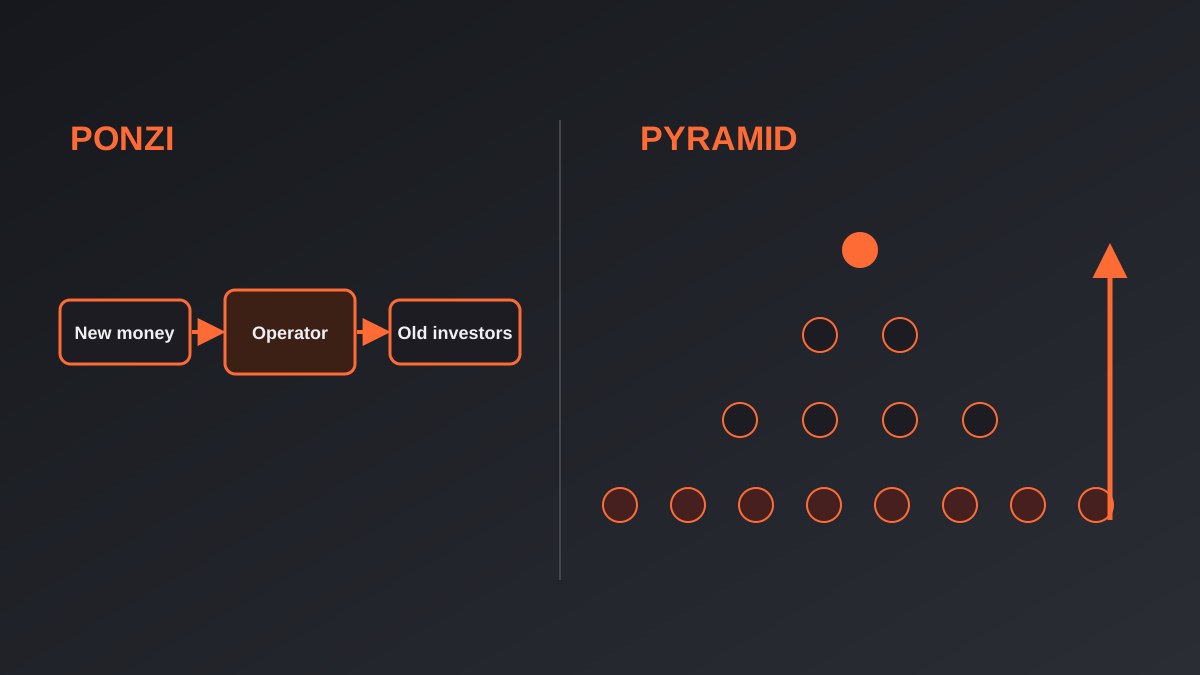
The short answer: in a Ponzi scheme, one operator collects money from investors and pays "returns" to earlier investors out of later investors' money, while claiming the cash is being invested. In a pyramid scheme, people pay to join and earn mainly by recruiting new members, whose fees flow up the chain. A Ponzi scheme hides the recruitment behind a fake investment. A pyramid scheme makes recruitment the product. Both need a constant supply of new money, and both collapse when it slows.
The two terms are often used as if they meant the same thing. Below: how each model works, where they overlap, what US, UK and Indian law prohibit, and a checklist to run before paying into any "opportunity".
How a Ponzi scheme works
The US Securities and Exchange Commission defines a Ponzi scheme as "an investment fraud that pays existing investors with funds collected from new investors." The organiser usually promises to invest the money and produce high returns with little or no risk. In many cases nothing is invested at all: the money pays earlier investors, and the organiser keeps a share. The name comes from Charles Ponzi, who drew investors into a postage-stamp speculation scheme in the 1920s.
- Investors are passive. You hand over money and wait. Nobody asks you to recruit, although early "winners" often bring in friends and family because the payouts look real.
- The story is about an investment. A trading strategy, foreign exchange, property, a private fund or crypto "arbitrage". The more complex and secretive the explanation, the harder it is to check.
- Returns look smooth. The SEC lists "overly consistent returns" as a red flag. Real investments rise and fall with markets.
- The operator controls the numbers. Statements and dashboards come from the scheme itself, so they can show anything.
A Ponzi scheme can run for years if withdrawals stay low and deposits keep coming. It usually ends one of two ways: new money dries up, or too many investors ask for their money back at once, which often happens during a market shock when people need cash.
The largest documented case is Bernard Madoff's investment advisory business. Madoff pleaded guilty in March 2009 to 11 federal felony counts and was sentenced to 150 years in prison. His firm's books had been audited by a tiny accounting practice whose only active accountant later pleaded guilty as well. It shows why auditor independence matters to anyone relying on a set of accounts.
How a pyramid scheme works
A pyramid scheme asks you to pay, through a joining fee, a "starter kit" or a compulsory monthly order, for the right to earn money by bringing in other people who pay the same. The US Federal Trade Commission draws the line by looking at where the money comes from. In a legitimate multi-level marketing (MLM) business, income comes mainly from selling products to real customers outside the network. In a pyramid scheme, it comes mainly from recruiting, and from purchases recruits make to stay "qualified" for bonuses.
- Participants recruit. You earn by signing people up, and they earn by signing up people below them.
- The product is thin or missing. Some pyramids sell nothing. Others attach a course, membership or product priced far above its value so the fee looks like a purchase.
- Money flows upward. Each level pays the levels above it. Early joiners near the top collect, and most people at the bottom lose what they paid in.
- The structure is usually open. Unlike a Ponzi scheme, the recruitment model is normally explained up front, because it is the pitch.
Why the maths always fails
Suppose every member has to recruit six people. The first level needs 6 recruits, the second 36 and the third 216. By the 11th level the scheme needs about 363 million new members (6 to the power of 11 is 362,797,056), which is more than the population of the United States. By the 13th level it needs about 13 billion people, more than everyone alive. Recruitment stalls long before that. When it does, the newest layer, which is always the largest, is left with the losses: most participants lose by design, not by bad luck.
Ponzi vs pyramid: the key differences
- Who brings in new money: In a Ponzi scheme, the operator and its marketing do. In a pyramid scheme, the participants do.
- What you think you are paying for: Ponzi investors think they are buying an investment. Pyramid members know they are paying for a position, often dressed up as a product.
- What you are told about returns: Ponzi operators claim profits come from trading or business activity. Pyramid promoters openly link earnings to recruitment.
- Who is in control: A Ponzi scheme has one central operator who handles all the money. A pyramid spreads payments across levels, with the top layers benefiting most.
- What makes it collapse: For a Ponzi scheme, it is falling deposits or a rush of withdrawals. For a pyramid, it is running out of new recruits.
Hybrids: where the two models meet
Many modern schemes mix both. A crypto "staking" or "trading bot" platform may promise fixed daily returns, which is the Ponzi half, and also pay "team bonuses" for signing up others, which is the pyramid half. Investment clubs with referral levels, "gifting circles", matrix plans and some app-based "task earning" schemes have the same shape. Related tactics are covered in our explainer on cryptocurrency market manipulation.
Whatever the label, the same test applies: if the money paid out to you can only come from money paid in by the next person, it is not an investment or a business.
MLMs are not automatically pyramid schemes
Multi-level marketing is legal in the US, UK and India when it follows the rules, but the FTC warns that some MLMs are illegal pyramid schemes. It also cautions that most people who join even legitimate MLMs make little or no money. Three questions separate the two:
- Are most sales made to customers who are not distributors themselves?
- Do you have to buy inventory, pay fees or place minimum orders to stay "active" or keep your bonus rank?
- Does the compensation plan pay more for recruiting than for selling to outside customers?
If the answers point to recruiting rather than retail sales, treat it as a pyramid, whatever the company calls itself. In India, also keep chit funds separate: a chit fund registered under the Chit Funds Act, 1982 is a regulated savings product, not a Ponzi scheme, although unregistered schemes sometimes borrow the name.
What the law says in the US, UK and India
- United States: Ponzi schemes are prosecuted as securities, wire and mail fraud, and the SEC brings civil cases to freeze assets. The FTC treats pyramid schemes as unfair or deceptive practices under the FTC Act, and the SEC can act when the "opportunity" is really an investment contract. Many states have their own anti-pyramid laws too.
- United Kingdom: Schedule 20 of the Digital Markets, Competition and Consumers Act 2024 lists "establishing, operating or promoting a pyramid promotional scheme" among commercial practices that are unfair in all circumstances. It defines one as a scheme where a consumer pays for the chance of compensation "derived primarily from the introduction of other consumers into the scheme rather than from the supply or consumption of products". Ponzi-type investment frauds are prosecuted as fraud, and offering unauthorised investments is a separate offence.
- India: The Prize Chits and Money Circulation Schemes (Banning) Act, 1978 bans money circulation schemes. The Banning of Unregulated Deposit Schemes Act, 2019 makes it an offence to run or promote deposit schemes that are not regulated. The Consumer Protection (Direct Selling) Rules, 2021 prohibit direct selling companies and their sellers from promoting pyramid or money circulation schemes.
A five-minute red-flag check
- Is the return fixed, high or "guaranteed"? Every real investment carries risk. A promise of steady monthly returns with no downside is the oldest Ponzi hook.
- Is the seller registered? In the US, check Investor.gov or FINRA BrokerCheck. In the UK, check the FCA Financial Services Register and the FCA Warning List. In India, check SEBI's list of registered intermediaries, and RBI's Sachet portal for warnings about unauthorised deposit-taking.
- Where would your payout come from? Ask for audited accounts and the name of the auditor, then check that the auditor exists and is licensed.
- Do you earn more by recruiting than by selling? If so, it is a pyramid.
- Is it hard to withdraw? Delays, new "release fees", lock-ins and pressure to reinvest are classic signs that the money is not there.
- Is the pressure social? Urgency, secrecy, glossy testimonials and pitches inside a religious, ethnic or professional community ("affinity fraud") are common. Trust in the group replaces checking the facts.
If you think you are already in one
Stop adding money and stop recruiting. Keep every message, receipt, statement and transfer record. Be wary of anyone offering to "recover" your losses for an upfront fee, because recovery scams often target the same victims. In large US cases, court-appointed receivers or trustees handle repayments and can sue to recover payouts that exceeded what an investor put in, so do not assume early profits are safe to keep.
Where to report:
- US: the SEC's tips portal (sec.gov/tcr) for investment schemes, and the FTC at ReportFraud.ftc.gov for pyramid and business-opportunity schemes.
- UK: Report Fraud (reportfraud.police.uk), which replaced Action Fraud in December 2025 for England, Wales and Northern Ireland. In Scotland, contact Police Scotland on 101. Report unauthorised investment firms to the FCA as well.
- India: the National Cyber Crime Reporting Portal (cybercrime.gov.in) or helpline 1930, RBI's Sachet portal for unauthorised deposit schemes, and SEBI's SCORES system for complaints about securities.
Insiders who see a scheme from the inside, such as staff, sales agents or bookkeepers, are often the first to spot it. Our look at whistle-blower protection explains what legal cover exists for people who report and where it falls short.
Sources
- US SEC, Investor.gov: Ponzi scheme definition and red flags
- US FTC: Multi-Level Marketing Businesses and Pyramid Schemes
- US Department of Justice, Southern District of New York: Madoff guilty plea (March 2009) and sentencing (June 2009) press releases
- UK legislation: Digital Markets, Competition and Consumers Act 2024, Schedule 20
- UK: Report Fraud (City of London Police)
- India, PIB: Consumer Protection (Direct Selling) Rules, 2021
- India Code: Prize Chits and Money Circulation Schemes (Banning) Act, 1978; Banning of Unregulated Deposit Schemes Act, 2019; Chit Funds Act, 1982
- Reserve Bank of India: Sachet portal
This article explains how fraud schemes work in general. It is not legal or investment advice. If you have lost money, contact the authorities listed above or a qualified lawyer.