Fraud Whistleblower Incentive Program: How the DOJ's New Rewards Work
The DOJ's new Fraud Whistleblower Incentive Program pays $10,000 to $30,000 when a tip leads to criminal fraud charges. Who qualifies and how it compares.
On this page
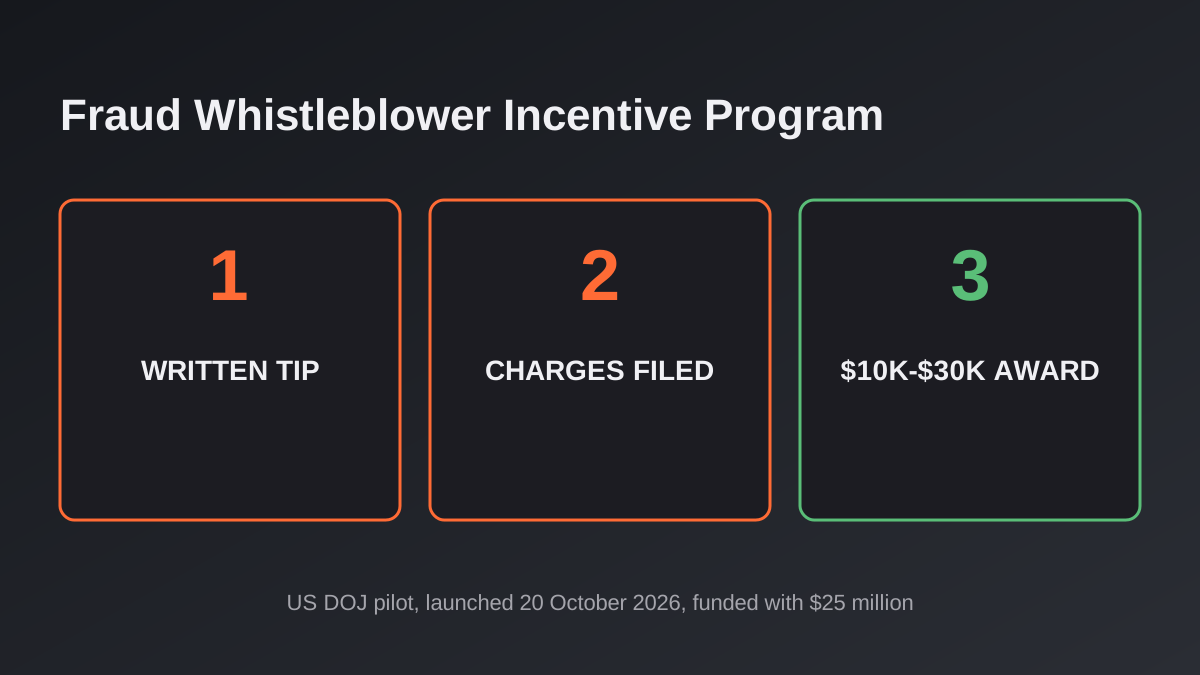
The short answer: the Fraud Whistleblower Incentive Program (WHIP) is a new US Justice Department pilot, announced on 20 October 2026, that pays a fixed reward of $10,000 to $30,000 to a member of the public whose written tip leads to criminal fraud charges. It covers health care fraud and fraud on federal benefit programs such as SNAP, unemployment insurance, student aid and SBA loans. The money is paid once charges are filed and unsealed, not years later after a conviction, but every award is at the department's sole discretion. Tips go through america.gov/fraud.
That speed is the genuinely new part. Most US whistleblower programmes pay only at the very end of a case. WHIP pays early and small, and it leaves the door open to larger awards later under other programmes. Below: what the official terms actually say, who is excluded, how the payment works, why the "1%" figure from the launch event confused people, and how WHIP compares with the False Claims Act, the SEC and the IRS programmes.
This is a general explainer based on the published programme terms, not legal advice. If you have inside knowledge of a fraud, speak to a qualified whistleblower lawyer before you report.
What was announced
On 20 October 2026 the Department of Justice and its National Fraud Enforcement Division (the "Fraud Division", created in April 2026) launched WHIP at a White House event with the President and Vice President. The DOJ press release describes it as the first government rewards programme that pays an up-front award for tips leading to criminal charges. The Treasury is committing $25 million to fund it.
Formally, the programme is the Fraud Division's Criminal Tip Rewards Pilot Program. Its published guidance gives it an initial three-year term and cites 28 U.S.C. § 530C(b)(1)(L), a law that lets the Justice Department pay rewards in response to public appeals for help. That legal basis matters: unlike some older whistleblower laws, it creates no automatic right to be paid.
Which frauds are covered
For now, the $10,000 to $30,000 award is limited to two areas:
- Health care fraud: federal health care offences and related crimes involving health care benefit programmes, or fraud against patients and others in the health care industry.
- Fraud on federal programmes and benefits run by the Departments of Agriculture (for example SNAP), Labor (for example unemployment insurance), Health and Human Services, Housing and Urban Development, Education (for example student aid), Veterans Affairs and War (Defense), and the Small Business Administration.
The department says it will prioritise tips about hospice, home health care, day care and special services fraud, and that more categories could be added later. There is no minimum loss: because the award is not tied to money recovered, even a tip about a scheme that failed can qualify if it leads to charges.
Who can qualify and who cannot
According to the programme guidance and FAQ, a tip has to be:
- Voluntary: not given because of a subpoena, a plea or cooperation agreement, or an existing investigation that already required it.
- Original: based on your own knowledge or your own analysis, not already known to the department, and not simply repeated from a court filing, a government report or the news.
- Specific, truthful, complete and timely, and submitted in writing, followed by full cooperation with any investigation and prosecution.
You are not eligible if you are a company rather than an individual; if you work for the Justice Department or a law enforcement agency (or are a close relative or household member of someone who does); if you are a foreign government official; or if you meaningfully took part in the fraud, for example by planning, directing or knowingly profiting from it. Law firm Debevoise & Plimpton notes a narrow carve-out for a "minimal participant". Information obtained through attorney-client privilege, from a legal engagement, or from certain audit and compliance roles generally does not count as original.
How and when the money is paid
The trigger is a charging document. If your tip leads prosecutors to obtain and unseal an indictment, an information or a criminal complaint, the department decides "promptly" whether to pay you. You do not have to wait for a guilty plea, a trial, sentencing or appeals, which in fraud cases can take years.
Three limits are worth knowing:
- One award per distinct tip. A tip that exposes a scheme run by several people is still one tip, and the department decides whether two tips are related.
- Sole discretion. The department can decline to pay. Debevoise reads the terms as making award decisions final, with no appeal or judicial review.
- Use the portal. The FAQ says an award can be refused solely because a tip did not come through america.gov/fraud.
A WHIP award does not stop you from claiming a larger award later under another programme, such as the Criminal Division's Corporate Whistleblower Awards Pilot Program, if the case ends in big penalties or forfeiture.
The "1%" confusion
At the launch event the President described the reward as a 1% commission on the fraud a tip uncovers, and said he would personally be involved in deciding who gets paid, according to reporting by CBS News and The New York Times. The written DOJ terms say something different: a defined award of $10,000 to $30,000, decided by the department at the charging stage. Whistleblower Network News pointed out that it is unclear how a percentage could even be calculated so early, before any money has been recovered.
For anyone thinking of reporting, the practical rule is simple: rely on the published terms at justice.gov/fraud/whistleblower, because those are what the department will apply, and check them again before you submit in case they change.
How WHIP compares with other US whistleblower programmes
| Programme | What it rewards | Award | When paid |
|---|---|---|---|
| Fraud Whistleblower Incentive Program (DOJ, 2026) | Tips leading to criminal charges for health care and federal-benefit fraud | $10,000 to $30,000, discretionary | When charges are unsealed |
| False Claims Act qui tam (31 U.S.C. § 3730) | Private lawsuits on the government's behalf over fraud on federal money | 15% to 25% of the recovery if the government joins, 25% to 30% if it does not | After a settlement or judgment |
| SEC Whistleblower Program | Securities law violations | 10% to 30% of sanctions over $1 million | After sanctions are collected |
| IRS Whistleblower Office (26 U.S.C. § 7623(b)) | Large tax underpayments | 15% to 30% of proceeds collected, where more than $2 million is in dispute | After the tax is collected |
| DOJ Corporate Whistleblower Awards Pilot (2024) | Corporate crime leading to forfeiture | A share of net forfeited proceeds | After forfeiture |
The trade-off is clear. WHIP is faster and more certain about timing, but the sums are small next to percentage-based awards. Whistleblower Network News, citing DOJ figures, reports that the False Claims Act brought in $6.8 billion in fiscal year 2025, over $5.3 billion of it from whistleblower-initiated cases, with more than $330 million paid to whistleblowers. False Claims Act cases are also filed under seal and come with a statutory anti-retaliation remedy in 31 U.S.C. § 3730(h). WHIP itself offers neither a court-supervised seal nor a mandatory award.
That is why an insider at a company with evidence of large-scale billing fraud may be better served by a qui tam lawyer than by a quick tip, while a neighbour or customer who spots a small benefits scam may find WHIP the more realistic route. Our reality check on whistleblower protection explains why legal protection on paper does not always stop retaliation in practice.
What WHIP does not cover
- Crimes that are not fraud. The FAQ says tips through the portal do not lead to non-fraud investigations and points people to local police or the FBI's Internet Crime Complaint Center instead.
- Allegations you only read about. Repeating a news story or a social media post is not original information and will not earn an award.
- Guaranteed confidentiality or job protection. The programme's own terms do not create the kind of statutory shield the False Claims Act or the SEC rules provide, so think about your position before you report.
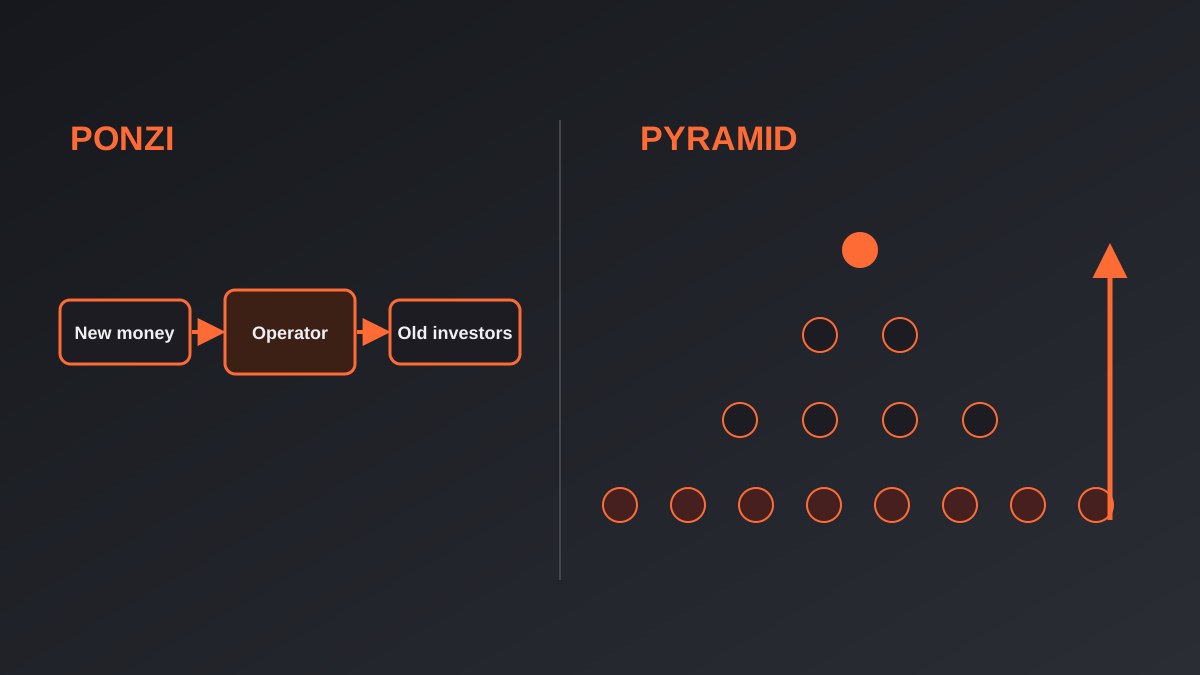
- Private consumer scams that do not touch a covered federal programme or health care benefits, such as most investment frauds. Those still belong with the FTC, the SEC or the police. Our guide to Ponzi and pyramid schemes covers the warning signs.
A practical checklist before you report
- Check the subject area. Is it health care fraud, or fraud on one of the listed federal programmes? If not, WHIP will not pay, though the FAQ still encourages reporting.
- Write down what you know first-hand: who, what, when, where, and how you know it. Stick to facts you can support, not guesses about motive.
- Do not take documents you are not entitled to or break the law to gather evidence. Describe what exists and where it is kept.
- If you are an employee or insider, talk to a whistleblower lawyer before reporting, because a qui tam case has its own filing rules and could be worth far more.
- Submit only through america.gov/fraud and keep a copy of what you sent.
- Watch for copycat scams. A new reward programme invites fake "fraud reward" sites and callers. Be wary of anyone who contacts you about a reward and asks for a fee or for bank details up front.
Fraud on public money thrives where oversight is weak; we looked at that pattern in government contract transparency and the defence contracting revolving door.
Frequently asked questions
How much does the Fraud Whistleblower Incentive Program pay?
Between $10,000 and $30,000 per distinct tip under the published DOJ terms. The amount and whether to pay at all are at the department's discretion.
Do I have to wait for a conviction to be paid?
No. The award is considered once an indictment, information or criminal complaint based on your tip is unsealed.
Can I report anonymously?
The terms require a written submission and full cooperation with the investigation, which in practice means the department needs to be able to identify and contact you. Read the portal's privacy terms before submitting.
Is WHIP better than the False Claims Act?
It is faster but pays far less. False Claims Act awards are a mandatory 15% to 30% of what the government recovers, so insiders with evidence of large frauds usually start there, with a lawyer.
Sources
- US Department of Justice: Justice Department Announces Innovative Whistleblower Rewards Program to Combat Fraud (press release 26-1231, 20 October 2026)
- DOJ National Fraud Enforcement Division: Whistleblower Rewards Program, programme guidance and terms and FAQs
- Debevoise & Plimpton: DOJ's Fraud Division Launches New Whistleblower Program (21 October 2026)
- Whistleblower Network News: New Trump Administration Whistleblower Program Offers Small, Non-Mandatory Awards (22 October 2026)
- AP News: Trump and Vance announce $25M whistleblower program to encourage public to report alleged fraud (20 October 2026)
- False Claims Act, 31 U.S.C. §§ 3729–3733; IRS whistleblower awards, 26 U.S.C. § 7623(b); SEC whistleblower program, 15 U.S.C. § 78u-6; 28 U.S.C. § 530C
This article explains a government programme in general terms and is not legal advice. Programme terms can change; confirm the current rules on justice.gov before you act.