Whistleblower Protection Act: Who Is Covered and Where to Report
On this page
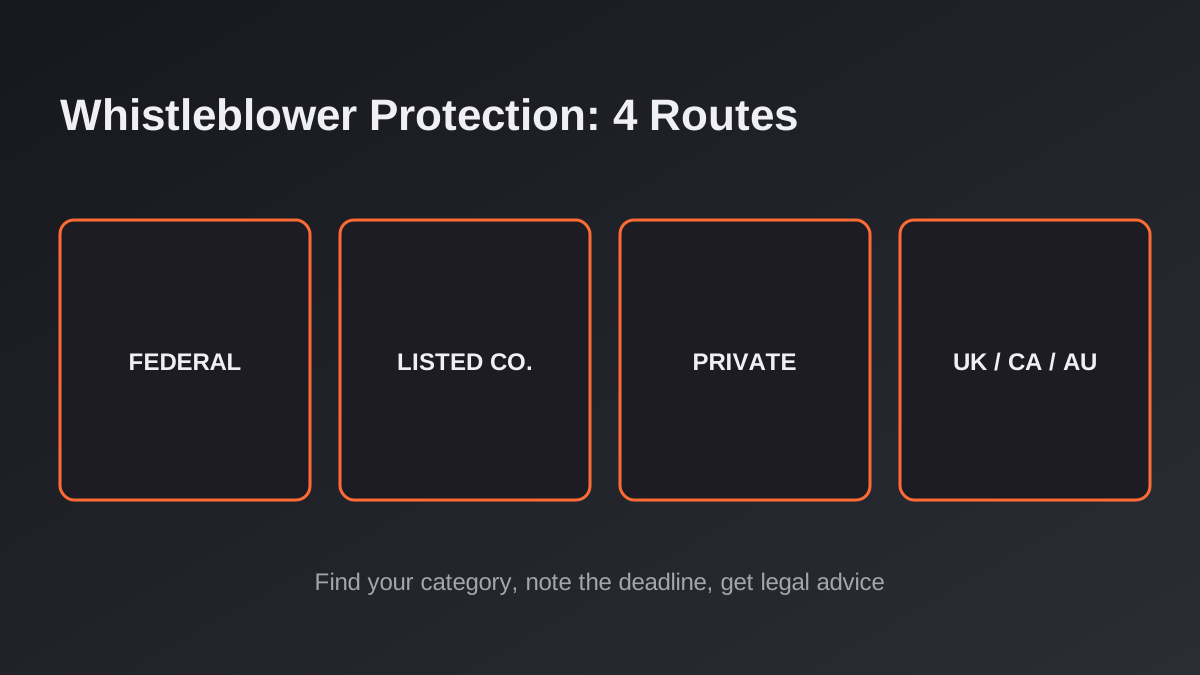
The short answer: there is no single "Whistleblower Protection Act" that covers everyone. In the US, the Whistleblower Protection Act of 1989 (strengthened in 2012) protects federal civilian employees, and the Office of Special Counsel (OSC) enforces it. Workers in private companies are protected by a patchwork of laws, more than 20 of which the Department of Labor's OSHA enforces, each with its own deadline, from 30 to 180 days. Which law applies depends on who your employer is and what you reported, so the first step is working out which channel and clock you are on.
Disclosures made through official channels do change things. On 8 October 2026 the OSC said a whistleblower's disclosure had prompted the IRS to restore its coordination function, provide training and update procedures for a group of tax filings tied to foreign ownership of US real estate, after a Treasury inspector general review confirmed operational gaps (OSC press release). That is the system working as designed: a disclosure to the right body, an independent review, a documented fix.
This is a general explainer based on the official sources listed at the end. It is not legal advice. If you are considering reporting, speak to an employment or whistleblower lawyer before you act.
What the Whistleblower Protection Act actually covers
The Whistleblower Protection Act (WPA) applies to the US federal civilian workforce. It sits inside the rules on "prohibited personnel practices", which are employment actions the federal government may not take because they violate the merit system. The OSC, which can investigate and prosecute these practices, lists 14 of them (OSC overview). Retaliation against a whistleblower is one.
The OSC's separate Disclosure Unit handles reports of wrongdoing from current and former federal employees and applicants. It reviews six types of disclosure:
- a violation of a law, rule or regulation;
- gross mismanagement;
- a gross waste of funds;
- an abuse of authority;
- a substantial and specific danger to public health or safety;
- censorship related to research, analysis or technical information.
Two details are easy to miss. First, the OSC does not investigate disclosures itself. It can require an agency head to investigate and report, then reviews whether that report looks complete and reasonable and sends the results to the President and congressional oversight committees (OSC disclosure process). Second, a disclosure and a retaliation complaint are different routes. You file a disclosure to report wrongdoing; you file a prohibited personnel practice complaint if you were punished for reporting it. Both go through the OSC's file-a-complaint page.
If you work in the private sector
The WPA does not apply to you. Instead, protection comes from the law that matches the subject of your report. OSHA says it enforces more than 20 whistleblower laws covering workplace safety, airlines, trucking, consumer products, the environment, financial reform, food safety, health insurance, nuclear, pipelines, public transport, railroads, maritime, securities, tax, antitrust and anti-money-laundering rules (OSHA whistleblower FAQ; full statute list).
The deadline is the part people get wrong. OSHA says filing windows range from 30 calendar days from when you learn of the adverse action (for example under Section 11(c) of the OSH Act, the general workplace safety law) up to 180 days, depending on the law. Most state-run OSHA plans also require complaints within 30 days of the adverse action. A missed window can end a valid case, so find the clock before anything else.
Public companies: Sarbanes-Oxley
Sarbanes-Oxley (SOX) section 806 protects employees of publicly traded companies, and their contractors and agents, who report conduct they reasonably believe is mail, wire, bank or securities fraud, a violation of an SEC rule, or fraud against shareholders. The statute protects reports made to a federal regulator or law enforcement agency, to Congress, or to a supervisor or another person at work with authority to investigate. You file with the Department of Labor, and the action must be commenced within 180 days of the violation or of when you became aware of it. If the Secretary of Labor has not issued a final decision within 180 days of your complaint, you can bring the case in federal court (18 U.S.C. §1514A text).
Securities tips: the SEC program
The SEC's whistleblower program is separate and has a financial incentive. It can pay awards to people who give high-quality, original information that leads to an enforcement action with more than $1 million in sanctions. Awards run from 10% to 30% of the money collected. Once a Notice of Covered Action is posted, there are 90 calendar days to apply (SEC Whistleblower Program). The SEC's list of largest awards includes a $50 million award dated 7 April 2026.
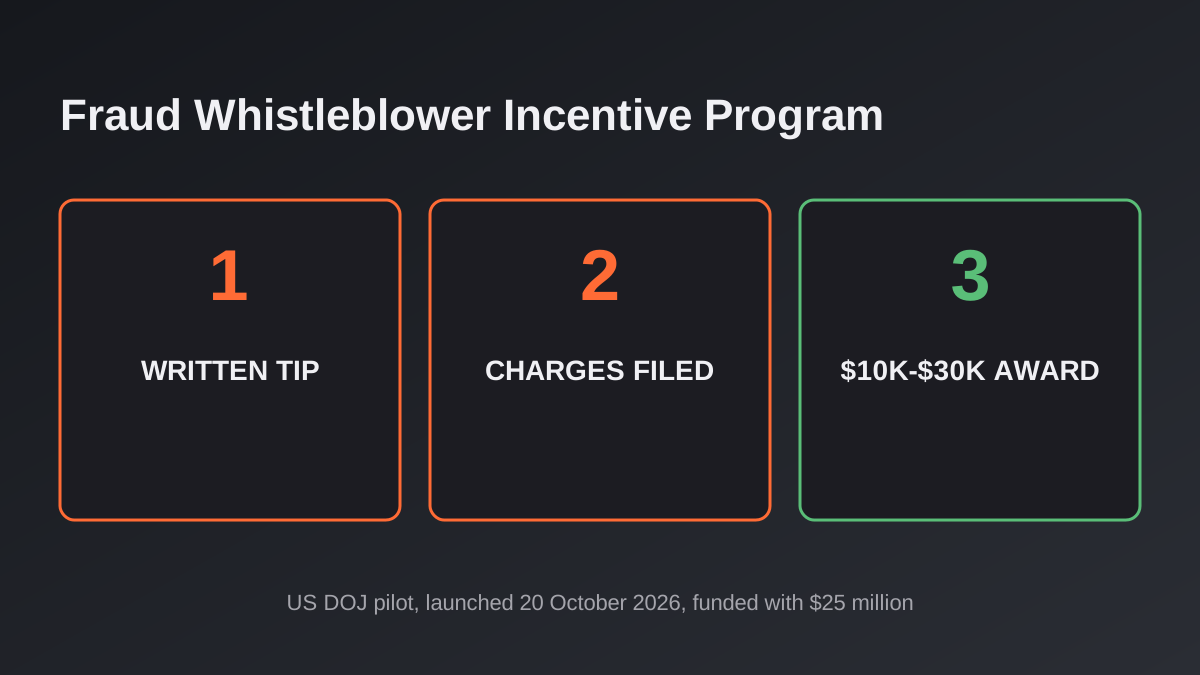
One legal point matters here. In Digital Realty Trust v. Somers (2018) the Supreme Court held that the Dodd-Frank anti-retaliation provision protects only people who reported to the SEC, not those who reported internally only. SOX covers internal reports, so the two laws protect different things. That is a reason to get legal advice on the order and channel of your reports, rather than assuming one report covers everything. For how the Justice Department's fraud-related reward scheme differs, see our explainer on the fraud whistleblower incentive program.
What counts as retaliation
OSHA defines an adverse action as one that would dissuade a reasonable employee from raising a concern. Beyond firing, its list includes demotion, denied overtime or promotion, discipline, reduced pay or hours, reassignment to a worse role, blacklisting, and constructive discharge (quitting because conditions became intolerable). It also includes subtler conduct such as isolating or mocking a worker, falsely accusing them of poor performance, or threatening to report them to the police or immigration authorities. All workers can file with OSHA regardless of immigration status.
Outside the US
- United Kingdom: the Public Interest Disclosure Act 1998 protects workers who make a "protected disclosure" about matters such as a criminal offence, danger to health and safety, damage to the environment, a miscarriage of justice, or a cover-up. The disclosure must be in the public interest. GOV.UK says confidentiality or "gagging" clauses are not valid if they try to stop a worker making a protected disclosure, and that disclosures can go to a lawyer, your employer or a prescribed person or body (GOV.UK whistleblowing guide; prescribed bodies list). A personal grievance about your own contract usually does not qualify unless it is also in the public interest. Time limits for employment tribunals are short, so seek advice from Acas or a lawyer early.
- Canada: federal public servants can disclose wrongdoing through the Office of the Public Sector Integrity Commissioner.
- Australia: ASIC explains whistleblower protections for corporate and financial-sector disclosures on its whistleblowing page.
A sensible order of operations
- Identify your category. Federal employee, public-company employee, other private-sector worker, or non-US worker? The category decides the law, the agency and the clock.
- Write down what you saw, when, and who knew, using your own notes and records you are entitled to keep. Do not copy privileged, classified or personal data you have no right to take; speak to a lawyer first about what is safe.
- Note the date of any retaliation the day it happens. Deadlines of 30 days are real.
- Choose the channel deliberately. An internal report, a regulator, and a rewards programme are different routes with different protections.
- Get independent legal advice before filing, particularly if you are signing a settlement or non-disclosure agreement.
If your concern is a scam or market manipulation rather than workplace misconduct, the reporting routes are different: see how to report a scam in the US and UK and how to report a pump-and-dump scheme. For why the protections can fall short in practice, read our reality check on whistleblower protection.
FAQ
Does the Whistleblower Protection Act cover private employees?
No. It covers federal civilian employees and applicants. Private-sector workers rely on other laws such as Sarbanes-Oxley, Dodd-Frank, OSHA-enforced statutes, and state laws, depending on the industry and the subject of the report.
How long do I have to file a retaliation complaint?
It depends on the law. OSHA says windows range from 30 to 180 days. SOX is 180 days. Check the specific statute for your situation as soon as retaliation starts.
Can I report anonymously?
Some channels accept anonymous or confidential reports, but anonymity can limit what an agency can do and what protections you can prove later. Ask a lawyer before choosing.
Do I need proof that the wrongdoing happened?
SOX protects reports of conduct you reasonably believe is a violation. You do not have to be proven right, but you should be able to explain what you saw and why you believed it. Never present suspicion as proven fact.
Sources
- US Office of Special Counsel: Prohibited Personnel Practices, Disclosure of Wrongdoing, File a Complaint, and the 8 October 2026 press release
- US Department of Labor / OSHA: Whistleblower FAQ, statutes, SOX §1514A
- SEC: Whistleblower Program (checked 2 November 2026)
- UK: GOV.UK, Whistleblowing for employees; Canada: Public Sector Integrity Commissioner; Australia: ASIC
- Supreme Court of the United States, Digital Realty Trust, Inc. v. Somers, No. 16-1276 (2018)
General awareness information, not legal advice. Laws and deadlines change and vary by state and country; confirm with the agency or a qualified lawyer before you act.