Recovery Scams: Why Someone Offering to Get Your Money Back Is a Second Scam
On this page
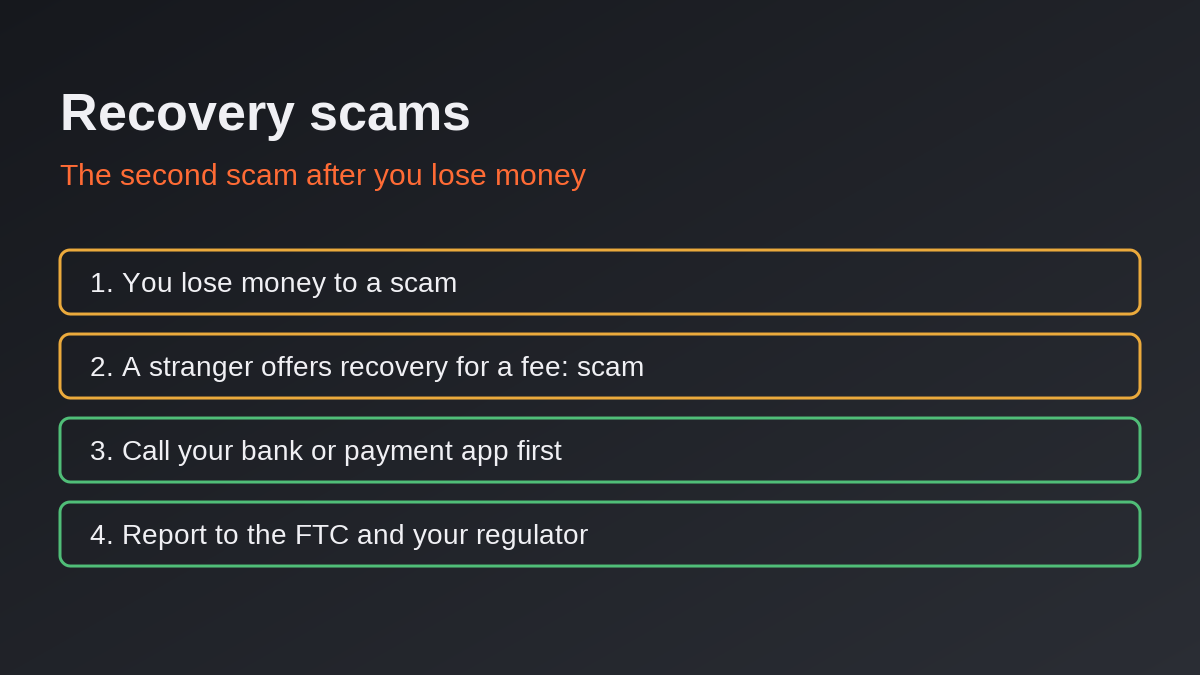
The short answer: anyone who contacts you out of the blue and offers to recover money you lost to a scam, in return for a fee or your bank details, is running a second scam. The US Federal Trade Commission (FTC) calls these refund and recovery scams "the worst of the worst" because they target people who have already been cheated. Genuine help starts with your bank or payment provider and a report to the authorities, and it never starts with an upfront payment.
How a recovery scam works
The FTC describes a repeating pattern:
- You paid a scammer first. It could be a fake prize, a timeshare resale, a bogus investment or any other fraud.
- Your details are sold on. The FTC says scammers buy, sell and trade lists of people who have already paid scammers, with names, contact details, the type of scam and the amount paid. Scammers expect people cheated once to be good targets again.
- A new contact arrives. It may be a call, letter, email, text or social media message saying someone can get your money or the prize you never received.
- They build trust. The FTC says the caller may claim to be from a government agency, a consumer group, a law firm, or even the company that took your money, now "offering refunds".
- Then comes the fee. You are told to pay a "retainer", "processing fee", "tax" or "shipment and handling charge", or to hand over your account number or Social Security number so a refund can be paid in. Once you do, the money disappears and your identity may be at risk.
Red flags that give it away
- It asks for money before any refund. The FTC says that if someone contacts you and asks for an upfront fee, that is a scammer, however they reached you.
- It claims to be an agency. According to the FTC, government agencies and legitimate organisations never ask for money to help you get a refund, never ask for your financial account numbers and will not guarantee that you will get your money back.
- It insists on a hard-to-reverse payment. The FTC says only scammers insist on cash, gift cards, cryptocurrency, wire transfers or a payment app.
- It sends a check for too much. If a "refund" check is for more than you lost and you are asked to send back the difference, that is always a scam. A fake check can take weeks to be found by the bank, and the bank will want its money back from you.
- It knows details about your earlier loss. That does not prove they are genuine. They may have bought them from a list.
What to do if you already lost money
Speed matters. The FTC says that if you paid a scammer, it is always worth asking the company you used to send the money whether it can be reversed. Which route applies depends on how you paid:
| How you paid | Who to contact first | What to ask |
|---|---|---|
| Zelle or bank transfer | Your bank or credit union | Reverse the payment and refund the money |
| Payment app (Venmo, Cash App, PayPal) | The payment app | Reverse the payment and refund the money |
| Wire transfer (Western Union, MoneyGram) | The wire transfer company | Tell them a scammer tricked you and ask for a refund |
| Credit or debit card | The card issuer, using the number on the card | Dispute the charge and ask for a refund |
| Gift card | The gift card issuer | Report the card number and PIN as given to a scammer |
| Cryptocurrency | The exchange or wallet company you used | Report the transaction and ask whether it can be reversed |
Results are never guaranteed, and some payments cannot be recovered. What matters is that you ask the real company directly, using a number you looked up yourself.
Report it, so your report helps others
- United States: ReportFraud.ftc.gov and your state attorney general. The FTC also points to IdentityTheft.gov if you gave out personal details. For other US options see our guide to reporting a scam in the US and UK.
- Elsewhere: the national fraud reporting service, for example Report Fraud in the UK, the Canadian Anti-Fraud Centre or Scamwatch in Australia.
A safe checklist for the first 24 hours
- Stop all contact with the person who took the money, and with anyone who contacts you offering to fix it.
- Contact your bank, card issuer or payment provider using a number from your card, statement or the provider's own app.
- Write down dates, amounts, names, phone numbers, account details and keep screenshots.
- If you shared personal details, follow the FTC's advice for placing a fraud alert or freeze, and change affected passwords.
- Report it to the authorities in your country.
- Tell a trusted friend or relative. Shame keeps many victims quiet, and that is what scammers rely on.
- If a "recovery company" contacts you, search its name together with "scam" or "complaint", and check with your state attorney general or national consumer agency before replying.
Are there any legitimate recovery routes?
Yes, but they come from official channels, not cold contacts. Your bank or card issuer can investigate disputes. Law enforcement can act on reports, and in some large cases the FTC returns money to people. In the Avast case, for example, the FTC said its $16.5 million settlement was expected to be used for consumer redress, which people can only claim through the agency itself. If a message promises you a refund and asks for a fee, treat it as fake and go to the agency's own website directly, typing the address yourself.
Questions people ask
Can a company guarantee to recover my money?
No. The FTC says legitimate organisations will not guarantee you will get your money back, so a guarantee is itself a warning sign.
Is it a scam if the caller knows how much I lost?
It can be. Scammers trade lists that record the amount paid and the type of scam. Verify who is contacting you through a number or website you find yourself.
What if I already paid a recovery scammer?
Treat it as a new scam: contact the payment provider, report it again and watch for identity theft. Do not send any more money, even if you are told the next payment will release the refund.
Sources
- FTC Consumer Advice: Refund and Recovery Scams, December 2023 (checked 29 November 2026)
- FTC Consumer Advice: What To Do if You Were Scammed (checked 29 November 2026)
- FTC press release: FTC Finalizes Order with Avast, 27 June 2024 (checked 29 November 2026)
General awareness information, not legal or financial advice. Agency procedures, hotlines and figures change; confirm with the relevant agency or your bank before you act.