Forensic Accounting: How Investigators Detect Fraud
On this page
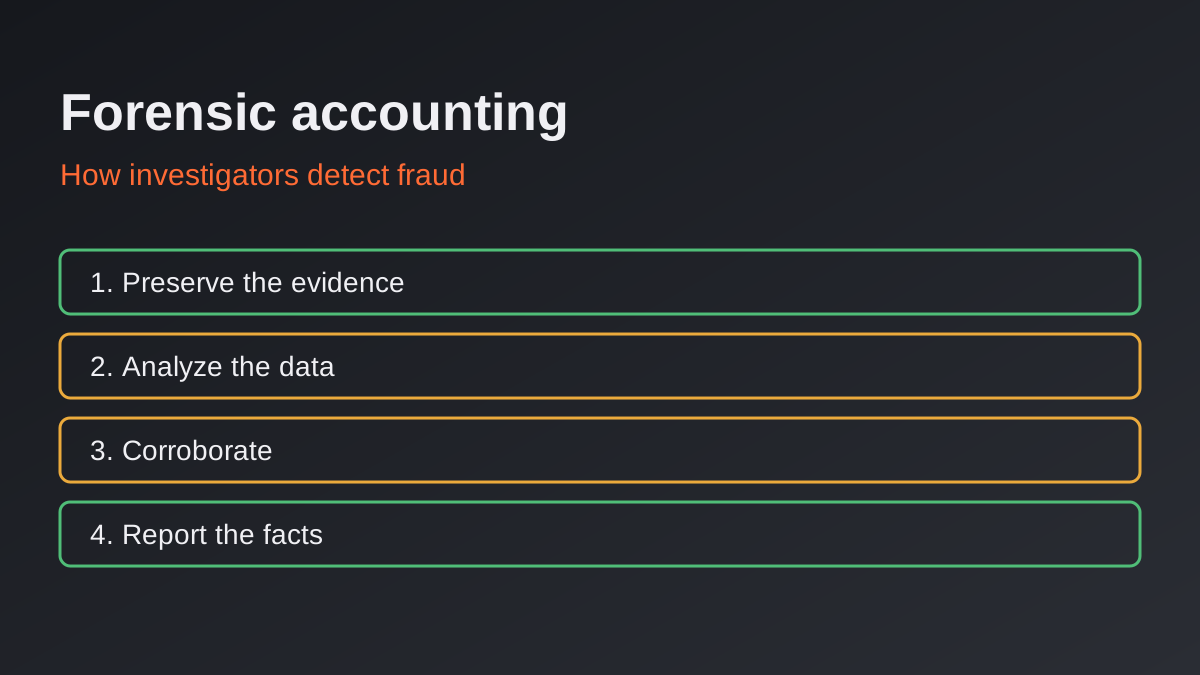
The short answer: forensic accountants detect and prove fraud by working in a fixed order. They preserve the records first, then test the data for patterns that do not fit normal business activity, then corroborate every anomaly with documents and interviews, and finally report facts that can stand up to a lawyer, regulator or court. The numbers flag where to look; they never prove intent by themselves.
The topic is timely. International Fraud Awareness Week, organised by the Association of Certified Fraud Examiners (ACFE) since 2000, runs 15 to 21 November 2026, and the US Treasury Inspector General for Tax Administration issued its own advisory for the week on 16 November (Accounting Today). It follows the ACFE's May 2026 study Occupational Fraud 2026: A Report to the Nations, which analysed 2,402 real cases from 143 countries and territories.
This is a general awareness guide based on the published sources listed at the end. It is not legal, audit or financial advice. It describes methods used by professionals; it does not tell you whether any specific person or company has committed fraud, and only a court or regulator can decide that.
What forensic accounting is
Forensic accounting applies accounting, auditing and investigative skills to a question that may end up in a legal setting: did money go missing, were the books misstated, and can that be shown with evidence? It differs from a normal audit in purpose. An audit gives reasonable assurance that financial statements are free from material misstatement. A forensic engagement starts from a specific concern, such as a tip, an odd variance or an allegation, and works to establish what happened, how, over what period and for how much.
Many practitioners hold the Certified Fraud Examiner (CFE) credential from the ACFE, or accounting qualifications such as CPA or chartered accountant status, but the title "forensic accountant" is not a single regulated profession everywhere. When you hire one, ask about credentials, experience in court or regulatory work and whether they work through your lawyer.
What the 2026 data says about how fraud is found
The ACFE's key findings give a useful baseline (ACFE press release):
- The cases caused more than $3.4 billion in losses, a median of $104,000 per case and an average above $1.4 million.
- Tips were again the top detection method at 43% of cases, and more than half of the tips came from employees.
- The median scheme ran 12 months before detection. Fraud caught within six months had a median loss of $40,000; schemes lasting more than five years had median losses above $1.1 million.
- Corruption appeared in 45% of cases. Financial statement fraud was only 6% of cases but had the highest median loss, about $1 million.
- Organizations that trained both staff and managers reported a median loss of $84,000, against $150,000 where neither group was trained.
Two lessons follow. Detection speed matters more than almost anything else, and a tip is usually how an investigation begins. Forensic work then turns a suspicion into a documented finding. If you are weighing whether to speak up, see our guide to who is covered by whistleblower protections and where to report.
Step 1: preserve the evidence
The first job is to stop evidence from changing. Investigators secure accounting system data, bank statements, emails, approval logs and devices, usually as forensic copies, and keep a chain-of-custody record showing who handled each item and when. They restrict access, suspend routine deletion and avoid tipping off the people involved. Mistakes at this stage, such as an IT team "tidying up" a laptop, can make later findings unusable, which is why serious cases start with a lawyer and a written scope.
Step 2: test the data for anomalies
Most modern engagements start with analytics across the whole ledger rather than a small sample. Common tests include:
- Journal entry testing. Entries posted at unusual times, by unusual users, as round amounts, just below approval limits or near period end are pulled for review. Auditing standards expect this too: the PCAOB's AS 2401 directs auditors to test journal entries and adjustments for signs of misstatement due to fraud.
- Benford's law. In many naturally occurring sets of numbers, the first digit is 1 about 30% of the time and 9 under 5%. Invented figures often break that pattern. A deviation is a prompt to look closer, not proof, because some legitimate data, such as fixed-price lists, also breaks it.
- Duplicate and sequence checks. Repeated invoice numbers, the same amount paid twice, gaps in cheque or invoice sequences and split purchases kept under a threshold.
- Vendor and payroll matching. Vendors sharing an address or bank account with an employee, payments to vendors that do not exist in the approved list, and "ghost" employees with no timekeeping history.
- Ratio and trend analysis. Revenue growing while cash from operations falls, receivables ballooning, or margins that never move when peers' margins do. Academic models such as the Beneish M-score combine several such ratios to estimate the likelihood of earnings manipulation; they screen, they do not convict.
- Lifestyle and related-party checks. The ACFE report notes that 84% of perpetrators showed at least one behavioural red flag before detection, such as living beyond their means, so investigators compare reported income with visible assets and look for undisclosed relationships.
Each test produces false positives. A round-number entry may be a legitimate accrual; a vendor at an employee's address may be a family business that was properly disclosed. The skill is in ranking the output and not drowning in it.
Step 3: corroborate with documents and interviews
An anomaly becomes a finding only when independent evidence supports it. Investigators trace a suspicious payment back to the invoice, purchase order, delivery record and approval, and forward to the bank account that received it. They then interview people, usually starting with those least involved and ending with the person at the centre, and compare the accounts with the documents. Interviews follow rules on fairness, legal rights and, in many countries, employment law, so counsel is normally present or consulted.
Investigators also look for innocent explanations on purpose. A report that cannot survive the question "what else could explain this?" is not ready. This is the same habit of professional scepticism auditors are meant to apply; for how independence affects that, see what auditor independence means.
Step 4: quantify and report
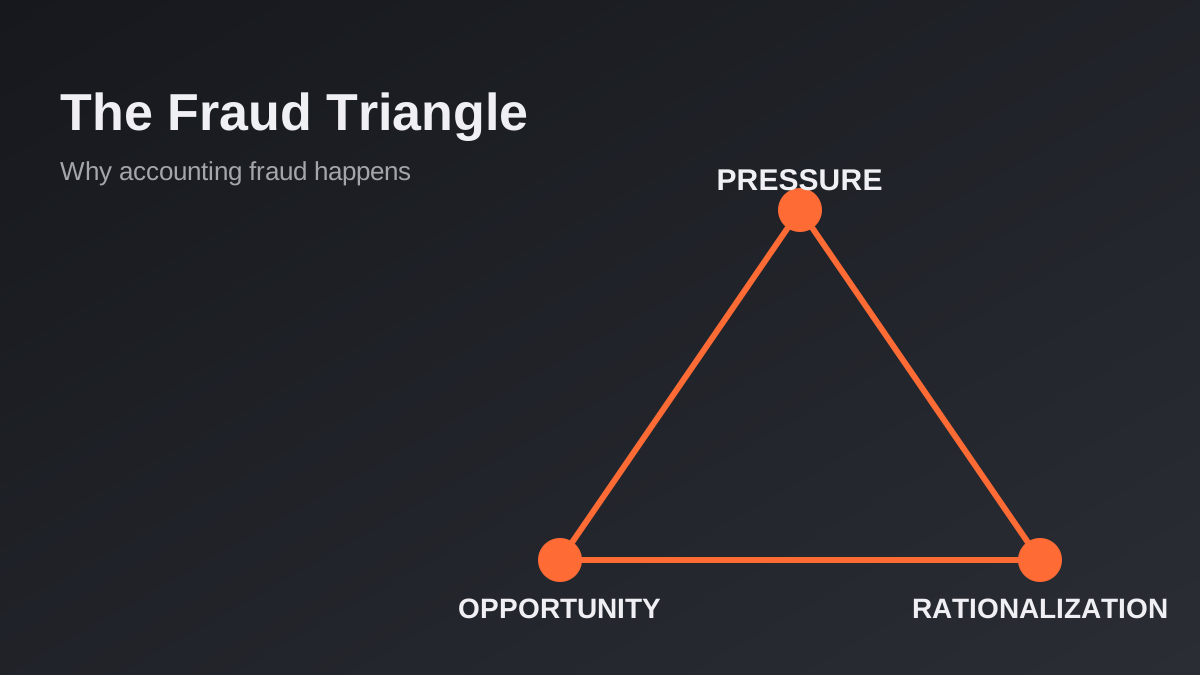
The final step is a written report that states the scope, the work done, the evidence, the amount involved and the limits of the analysis. Forensic accountants may be asked to act as expert witnesses and must be able to explain every figure. Reports avoid conclusions about guilt or intent; those are for courts and regulators. In listed-company cases the facts may support a referral to regulators or law enforcement, and anyone with information about securities fraud can report to the SEC. For the root causes that make this work necessary, read the fraud triangle explained.
What forensic accounting cannot do
- It cannot read minds. Intent is inferred from evidence and decided by others.
- It cannot recover money by itself. Recovery needs legal action, insurance claims or negotiated settlements.
- It cannot fix weak controls after the event. The ACFE data shows controls, training and reporting channels are associated with lower losses and faster detection.
- It cannot work from poor records. Missing logs and informal processes limit what can be proven.
Practical steps for small businesses and managers
- Offer more than one way to report. The ACFE found web and email reporting now exceed phone hotlines.
- Separate duties. The person who approves payments should not also record them or reconcile the bank account.
- Review exceptions monthly. Duplicate payments, new vendors, manual journals and write-offs.
- Take it seriously the first time. Contact your lawyer before confronting anyone, and keep original files untouched.
- Know when to escalate. If shares or investors are involved, read how to report market manipulation and use the regulator's official channel.
Frequently asked questions
Is a forensic accountant the same as an auditor?
No. An auditor gives an opinion on financial statements using sampling and risk assessment. A forensic accountant investigates a specific concern and builds evidence for a legal or regulatory purpose. The two use similar skills, but their scope and standards differ.
Does a Benford's law failure prove fraud?
No. It shows that the data does not follow the expected digit pattern. Legitimate reasons include price points, caps and small sample sizes. It tells investigators where to look first.
How long does a forensic investigation take?
It depends on scope, the volume of records and whether litigation is involved. Simple payroll or expense reviews can take weeks; complex, multi-year or cross-border cases can take many months.
Who pays for it?
Usually the organisation, an insurer under some policies or a regulator in public cases. Costs are one reason early detection matters.
Sources
- ACFE: Key Findings from Occupational Fraud 2026: A Report to the Nations (checked 19 November 2026)
- ACFE: Report to the Nations (2,402 cases, 143 countries and territories)
- Accounting Today: ACFE kicks off International Fraud Awareness Week, 16 November 2026
- PCAOB: AS 2401: Consideration of Fraud in a Financial Statement Audit
General awareness information, not legal, audit or financial advice. Laws, agency procedures and standards change and vary by country; confirm with the relevant regulator or a qualified professional before you act.