Gold Bar Scams: How the Courier Fraud Works and What to Do
On this page
The short answer: any call, text, email or pop-up that tells you to buy gold bars, withdraw cash or "move your money to protect it" and then hand it to a courier is a scam, whoever says they are asking. Real government agencies, banks and police do not ask this. The FTC says so directly, the FBI has warned about courier pick-ups since January 2024, and the scheme is still being reported this month.
The topic is current. On 12 November 2026 local and national outlets reported that the NYPD was seeking a suspect after a man on Manhattan's Upper West Side handed over roughly $9 million in gold bars in what police described as a scam, and the story was still being covered on 17 November. This guide explains the script, why gold and couriers are used, what the official figures show, and what to do if you or a relative have already acted. It is an awareness guide based on the official sources listed at the end.
No individual is accused here. News reports describe an investigation; any suspect is presumed innocent unless a court finds otherwise.
How the gold bar scam works
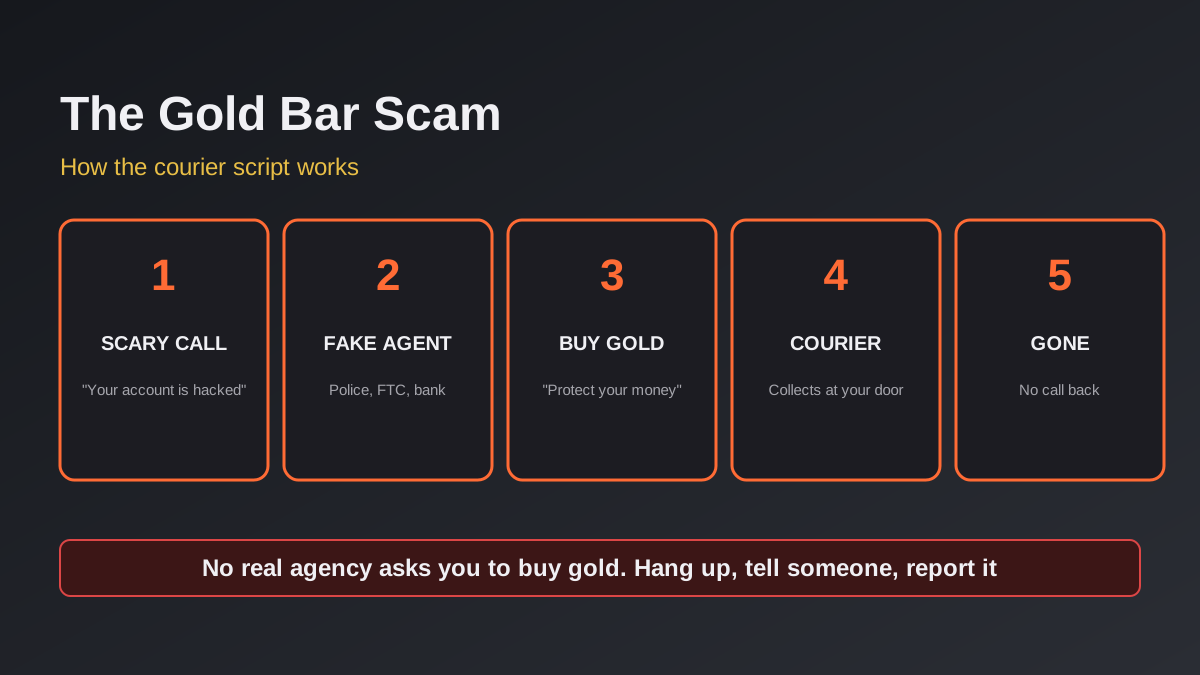
The FBI's Internet Crime Complaint Center (IC3) described the pattern in a public service announcement and the FTC repeated it in a July 2025 consumer alert. The details vary, but the steps are usually the same:
- A frightening first contact. A pop-up tells you to call a "support line", or a message says your bank account or computer was hacked, or that your name and Social Security number are linked to a crime. The caller claims to be a government agent or law enforcement.
- A hand-off up the chain. The FBI notes scammers sometimes pose in succession as a technology company, a financial institution and a government official. Each "expert" makes the story sound more official.
- The "protect your money" instruction. You are told your funds are at risk and must be liquidated into cash, gold, silver or other precious metals, or moved to a "secure" or "government" account. Sometimes you are told to wire money to a metal dealer who ships the bars to your home.
- Pressure to act fast. The FTC notes scammers pressure you to move quickly, which is why its advice is to stop and tell someone you trust before doing anything.
- The courier. A courier collects the cash or bars at your home or a public place. The FBI says victims may be given a passcode, such as the serial number of a dollar bill, to "authenticate" the pick-up.
- Silence. You are told the assets will be safeguarded. In reality, the IC3 notice says, victims never hear back from the scammers and lose all their money.
Why gold and couriers?
Bank transfers can sometimes be flagged, paused or recalled. Cash and gold handed over in person cannot. The courier is also a shield: in many cases the person at the door is only a pick-up driver, so the trail to the people running the scheme is harder to follow. The FTC puts it simply: it does not matter who they say you are giving the bars to. Do not hand them to a courier and do not deliver them anywhere.
The same idea shows up in other forms. The FBI's Boston office notes that grandparent, government impersonation and tech support scams can all end with a courier collecting cash or gold. If you have read our guide to scams targeting older adults, this is the same pressure, with an in-person last step.
What the official numbers show
- FBI IC3, January 2024: from May to December 2023 the IC3 saw an uptick in this activity, with aggregated losses of over $55 million. The FBI said many victims are senior citizens.
- FBI Boston, 2025: from 2023 to May 2025 the FBI documented at least 1,737 cases nationwide in which a courier was used to collect bulk cash or gold bars, with losses of roughly $186 million. In the New England states covered by that office, 103 cases totalled about $26 million, and roughly 98 percent of those losses were reported by people over 60. The FBI says real losses are likely higher because many victims are ashamed or do not know where to report.
- FTC, 15 June 2026: consumers reported losing $3.5 billion to imposter scams in 2025, and about $920 million of that to government impersonators, up from about $789 million in 2024. Reported fraud losses of all kinds were about $16 billion, the highest on record. Gold bar scams are one costly slice of the government-impersonation category, not a separate total.
These are reported figures. They count only people who filed a complaint.
Phrases that mean it is a scam
The FTC's alert lists three lines to listen for. Each one is a scam every time:
- "Buy gold bars and hand them to someone."
- "Move your money to protect it." Nobody legitimate will tell you to protect your money by transferring or withdrawing it from your bank or investment accounts.
- "Withdraw cash and give it to someone."
Other warning signs from the FBI and FTC guidance: an unexpected pop-up telling you to call a number; a caller who says your accounts are "compromised" and that the only fix is to move or withdraw the money; a request to install software or let someone control your computer; a caller ID that looks official (caller ID can be faked); and any request for your home address so a courier can come.
What to do if you get a call like this
- Stop and hang up. Delete the email, close the pop-up, stop texting. Do not call the number in a pop-up or message.
- Do not buy, withdraw or hand over anything. No government agency or legitimate business will ask you to purchase gold or other precious metals.
- Never give your home address or agree to meet someone to deliver cash or metals.
- Call your bank yourself on the number printed on your card or statement, not one the caller gave you.
- Tell someone you trust before you do anything else. Scammers rely on isolation.
- Report it, even if you did not lose money. See the next section.
If you or a relative already handed something over
Speed matters, but so does staying calm; being deceived is not a character flaw. The scripts are built by professionals.
- If a courier is on the way or at the door, call 911. Do not hand anything over.
- Contact your bank or the gold dealer immediately if you wired money or bought bars. Ask whether the transaction can be stopped or flagged.
- File at ic3.gov as quickly as possible, as the FBI asks. Include the name of the person or company that contacted you, the methods used (websites, emails, phone numbers), any bank account numbers and recipient names you wired money to, and the dealer's name, location and account if you bought metals.
- Report to the FTC at ReportFraud.ftc.gov.
- Victims aged 60 or over who need help filing can contact the DOJ Elder Justice Hotline at 1-833-FRAUD-11 (833-372-8311), as listed in the FBI's notice.
- Keep every record: dealer invoices, bar serial numbers, the pick-up date, time and place, a description of the courier, the passcode used, and all phone numbers and messages. Do not delete the original messages.
- Be wary of "recovery" offers. People who have been defrauded are often contacted by someone promising to get the money back for a fee. Treat unsolicited offers as another scam and use official channels only.
Our guide to how to report a scam in the US and UK lists every agency, including Canada and Australia, and the SIM swap scams guide covers a related account-takeover route scammers use before the phone call.
Outside the US
The same pattern is not limited to the United States. In the UK, police use the term "courier fraud" for scams where a caller poses as police or a bank and sends someone to collect cash, cards or valuables. Report it through Report Fraud, and call 159 to reach your own bank on a number you know is genuine. In Canada, report to the Canadian Anti-Fraud Centre, and in Australia to Scamwatch. The rule that travels everywhere: a genuine police officer, bank or government agency will not send a courier to your door for your money or valuables.
Frequently asked questions
Is the gold bar scam real?
Yes. The FTC published a consumer alert about it in July 2025, the FBI IC3 issued a public service announcement in January 2024, and the FBI Boston office reported documented courier cases across the country in 2025.
Who gets targeted?
Many victims are older adults. The FBI said many victims in its notice are senior citizens, and FBI Boston reported that roughly 98 percent of the losses it documented in its area came from people over 60. Anyone can be targeted, however, because the story is designed to frighten whoever answers.
Does the FTC or any government agency ever ask you to buy gold?
No. The FTC says no one from the government will tell you to buy and deliver gold bars, move your money or give cash to anyone. The FBI says the US government and legitimate businesses will never request that you purchase gold or other precious metals.
Can I get my money or gold back?
Sometimes a bank can stop a wire that has not completed, which is why contacting it at once matters. Gold or cash handed to a courier is much harder to recover. Report quickly, keep all records and do not pay anyone who promises recovery for an upfront fee.
Where do I report it?
In the US, the FBI IC3 (ic3.gov) and the FTC (ReportFraud.ftc.gov). In the UK, Report Fraud. In Canada, the Canadian Anti-Fraud Centre. In Australia, Scamwatch. Call 911 (or your local emergency number) if a courier is at the door.
Sources
- FTC Consumer Alert: Real government agents aren't asking you to buy and deliver gold bars, July 2025 (checked 17 November 2026)
- FBI IC3: Scammers Use Couriers to Retrieve Cash and Precious Metals from Victims of Tech Support and Government Impersonation Scams, PSA240129, 29 January 2024 (checked 17 November 2026)
- FBI Boston: FBI Boston Warns of Increase in Gold Bar and Bulk Cash Courier Scams, 2025
- FTC press release: FTC Data Show People Reported Losing $3.5 Billion to Imposter Scams in 2025, 15 June 2026 (checked 17 November 2026)
- FTC: How To Avoid a Government Impersonation Scam
- News coverage of the NYPD investigation, 12 to 17 November 2026 (NBC News, Audacy, SILive, West Side Rag)
General awareness information, not legal or financial advice. Agency procedures, hotlines and figures change; confirm with the relevant agency or your bank before you act. If you are in immediate danger or a courier is at your door, call your local emergency number.