Holiday Scams 2026: Which Payment Methods Protect You
On this page
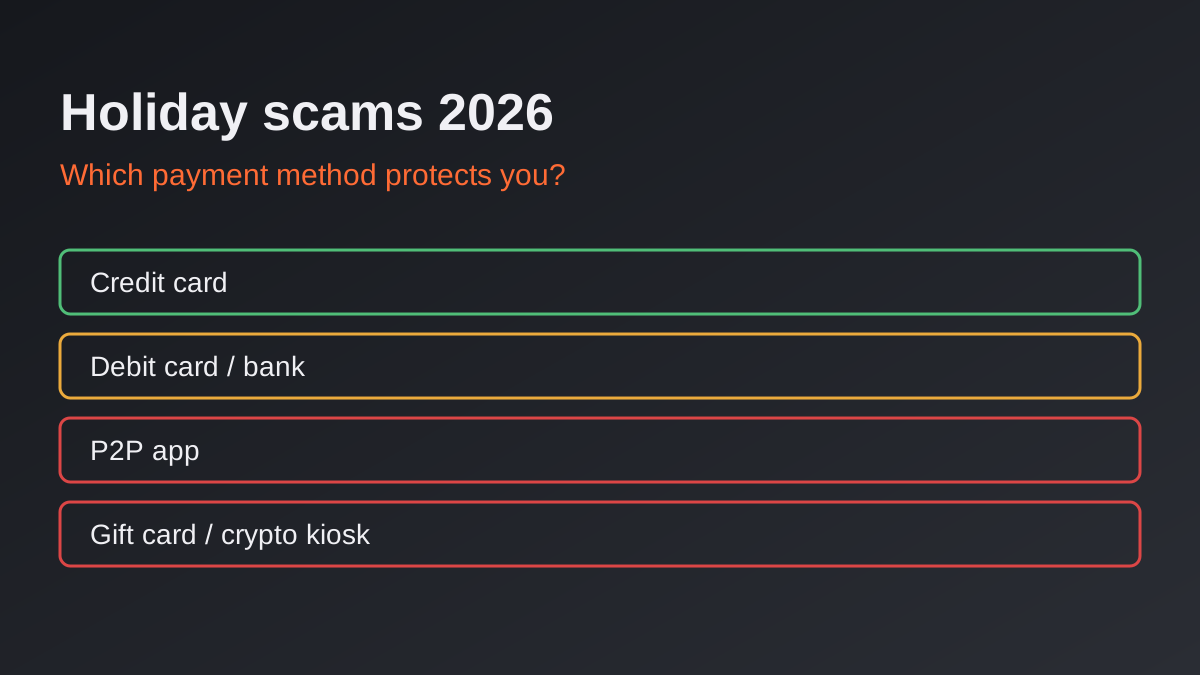
The short answer: for holiday shopping, a credit card gives you the strongest legal route to get money back in the US, a debit card or bank transfer gives you some protection, and peer-to-peer (P2P) apps such as Cash App, Zelle and Venmo are built for paying people you know, not strangers or online sellers. Gift cards and crypto-machine payments are the ones scammers ask for because they are very hard to reverse. Choose the payment method before you click "buy", because the method decides your options afterwards.
The topic is timely. On 11 November 2026 AARP's Fraud Watch Network published its holiday survey, "Unwrapping the Truth", based on 1,801 US consumers aged 18 and over. It found that 84 percent had experienced or been targeted by at least one kind of fraud that is common around the holidays, and that only 25 percent answered seven or more of its ten true-or-false fraud questions correctly (AARP). The quiz question that stood out for this guide: only 31 percent knew that P2P apps do not have the same consumer protections as a credit card.
This is a general awareness guide based on the official and published sources listed at the end. It is not legal or financial advice. Rules differ by country, bank, card issuer and app, and individual outcomes depend on the facts; confirm with your provider before you act.
What the AARP survey says about holiday scams
The survey asked about the previous year. These are AARP's figures for US respondents:
- 47 percent had received a message claiming to be from the US Postal Service, FedEx or UPS about a shipment problem that turned out to be fraudulent.
- 44 percent had received a scam text about an unpaid toll; 9 percent clicked the link and paid.
- 35 percent had given or received a gift card with no money on it.
- 31 percent had received a donation request that seemed fraudulent.
- 16 percent had been defrauded when trying to buy a product through an online ad. That is down sharply from 39 percent in the previous year's survey, though still roughly one shopper in six.
- 16 percent of travellers had experienced fraud when booking a trip, such as paying for a flight, car rental or place to stay that turned out not to exist.
AARP also notes that criminals place professional-looking ads on social media that lead to convincing shop sites, so a shopper may receive an inferior product or nothing at all. A sensible habit is to treat any ad or link as a starting point only: go to the retailer's own site by typing its address, and look the seller up before you pay.
Credit card: the strongest US protection
In the US, credit cards are covered by the Fair Credit Billing Act. If your statement shows a billing error, including a charge for goods that were not delivered as agreed, you can dispute it. The law (15 U.S.C. 1666) sets the process:
- Send the card issuer a written notice within 60 days of the date it sent the statement showing the charge. The notice should identify you and your account, say you believe there is a billing error, state the amount and give your reasons.
- The issuer must acknowledge your notice within 30 days.
- It must resolve the dispute within two complete billing cycles, and no later than 90 days, either correcting the account or explaining in writing why it believes the charge is right. For goods you say were not delivered, it cannot treat the charge as correct unless it determines the goods were actually sent and gives you a statement of that.
That is why AARP's quiz treats a credit card as the safest way to buy online. Many issuers also offer their own dispute tools in the app, which is usually faster to start; still keep the written notice in mind for the legal timelines. Use a card with a clear dispute process, keep order confirmations and screenshots of the listing, and do not wait for the statement if you can see the charge sooner.
Debit card or bank transfer: some protection, with a catch
Debit cards and many bank payments fall under Regulation E, the US rule for electronic fund transfers. It limits what you can be made to pay for an unauthorized transfer. Under 12 CFR 1005.6, liability is capped at $50 if you tell the bank within two business days of learning of the loss or theft of the access device, and at up to $500 if you wait longer. You should also report an unauthorized transfer that appears on a statement within 60 days to avoid losing protection for later transfers. Once you report an error, the bank generally has to investigate within 10 business days, or up to 45 days if it credits your account provisionally in the meantime (12 CFR 1005.11).
The catch is the definition. The regulation defines an unauthorized transfer as one initiated by a person other than you, without actual authority, and from which you receive no benefit (12 CFR 1005.2(m)). If someone steals your card number and uses it, that is the situation the rule was written for. If a scammer persuades you to send the money yourself, the bank may not treat it as unauthorized, and how a given case is handled can vary. Report it at once anyway: some providers can recall or flag a payment in the first hours, and the report costs nothing.
P2P payment apps: pay people you know
AARP's quiz answers are blunt. P2P apps like Cash App, Zelle and Venmo do not have the same consumer protections as a credit card, and they are generally intended for sending money to people you personally know, such as family, friends or a babysitter. Sending money for a vacation rental found on a platform like Airbnb or VRBO outside that platform's own payment system is not safe either. Only 46 percent of respondents got that last question right.
In practice, treat a P2P app like handing over cash. If a seller you found online asks for Zelle, Venmo or Cash App "friends and family" payment, or says the card fee is too high, walk away. Our guide to reporting an Apple Pay or Apple Cash scam explains why it matters which money actually moved, and who to call first.
Gift cards and crypto machines: the red-flag methods
AARP notes that gift cards are a favourite gift and also a favourite of criminals. Its quiz answer on crypto is clear: if you are directed to send someone money by converting cash into cryptocurrency at a convenience-store kiosk, it is a scam (63 percent of respondents knew this). A genuine retailer, toll authority, delivery firm or government agency should not demand payment in gift cards or through a crypto machine. If a stranger asks for either, stop. See our guide to pig butchering scams for how those requests are used in longer investment cons.
Outside the United States
- UK: under section 75 of the Consumer Credit Act 1974, a credit card holder can have a claim against the card provider for misrepresentation or breach of contract by the seller, for a single item with a cash price above £100 and up to £30,000 (legislation.gov.uk). For bank-to-bank payments, the Payment Systems Regulator describes reimbursement rules for authorised push payment (APP) scams on Faster Payments and CHAPS, under which most victims are to be reimbursed within five business days (PSR). Contact your bank first; if you are unhappy with its answer, the Financial Ombudsman Service is the next step.
- Canada and Australia: report through the Canadian Anti-Fraud Centre or Scamwatch and contact your bank at once.
A quick check before you pay
- Type the retailer's address yourself. Do not follow a link in a text, email or ad.
- Search the seller's name with "scam" or "reviews", and check how long the shop has existed.
- Pay by credit card where you can. Keep P2P apps for people you know.
- Be suspicious of any price that is far below every other shop, and of pressure to pay now.
- Never call a number from a search result for "customer service" without checking it on the company's own site. AARP's quiz found 77 percent knew the first number that appears is not always the real one.
- Update your phone and computer software. AARP's quiz includes this as true: regular updates protect against fraud.
If you already paid a scammer
- Contact the payment provider immediately. Call the card issuer, bank or app. Say it was fraud and ask what can be disputed, recalled or blocked.
- Change passwords and secure your accounts if you shared a login, code or card details.
- Report it. In the US, file at ReportFraud.ftc.gov, and with the FBI's Internet Crime Complaint Center (IC3) if it was an internet crime or a large loss. In the UK, report through Report Fraud and tell the FCA about any firm you suspect.
- Keep evidence. Screenshots, receipts, usernames, phone numbers and message threads.
Our guide on how to report a scam in the US and UK lists each agency, and scams targeting older adults covers the warning signs to share with relatives who shop online.
Frequently asked questions
Is a credit card really safer than Zelle, Venmo or Cash App for online shopping?
For purchases from sellers you do not know, yes. A credit card gives you a dispute process under the Fair Credit Billing Act, while AARP's holiday survey states P2P apps do not have the same protections as a credit card and are meant for people you know.
Does Regulation E refund me if I send money to a scammer myself?
Not automatically. Regulation E is built around unauthorized transfers, meaning transfers initiated by someone other than you without actual authority. If you are tricked into sending the payment yourself, the bank may not treat it as unauthorized. Report it immediately and ask what your bank can do.
How long do I have to dispute a credit card charge?
For a billing error under the Fair Credit Billing Act, your written notice generally has to reach the issuer within 60 days of the date it sent the statement showing the charge. Act sooner if you can, and use the issuer's app or phone line as well.
Are unpaid toll texts real?
Many are not. AARP found 44 percent of respondents had received a scam text about an unpaid toll in the past year, and 9 percent clicked the link and paid. Check your balance on the toll operator's own website or app, never through a link in a text.
Where do I report a holiday shopping scam?
In the US, report to the FTC at ReportFraud.ftc.gov and to the FBI IC3 if it was an internet crime. In the UK, use Report Fraud. In Canada, use the Canadian Anti-Fraud Centre, and in Australia, Scamwatch. Contact your card issuer or bank first.
Sources
- AARP: How Much Do You Know About Holiday-Related Scams in 2026?, 11 November 2026 (checked 15 November 2026)
- US Code: 15 U.S.C. 1666, Correction of billing errors
- eCFR (via Cornell LII): 12 CFR 1005.2, 1005.6 and 1005.11 (Regulation E)
- UK legislation: Consumer Credit Act 1974, section 75
- UK Payment Systems Regulator: Our work to prevent APP fraud
General awareness information, not legal or financial advice. Laws, agency procedures and deadlines change and vary by country and state; confirm with the relevant regulator, your bank or a qualified professional before you act.