Scams Targeting Older Adults: Warning Signs and Where to Report
On this page
The short answer: older adults are targeted by the same scams as everyone else, but they lose far more per incident, and the biggest losses come from investment scams, impersonation calls and fake security alerts. If you or someone you know is 60 or older and has lost money, stop sending funds, call your bank first, then report to the FTC at ReportFraud.ftc.gov, the FBI's IC3 for anything online, and the US National Elder Fraud Hotline on 833-FRAUD-11 (833-372-8311). In the UK, use Report Fraud on 0300 123 2040.
The numbers are fresh. On 19 October 2026 the US Federal Trade Commission (FTC) sent Congress its latest report on protecting older consumers, built on reports filed in 2025. It found that fraud losses reported by people aged 60 and over rose about fivefold in five years, from roughly $600 million in 2020 to approximately $3 billion in 2025, driven largely by a growing number of very large individual losses. Losses to investment scams alone jumped 42 percent in 2025 to more than $1 billion, and the FTC says consumers report that scammers often reach them on social media. The FTC also estimates that the overall cost of fraud to older adults in 2025 could be as high as $119.5 billion once under-reporting is taken into account.
This guide turns those findings into something practical: the scams to know, the warning signs that matter most, what to do in the first hour after a loss, and where to report in the US, UK, Canada and Australia.
This is a general awareness guide based on the official sources listed at the end. It is not legal or financial advice.
What the FTC's 2026 report actually says
Four findings from the FTC's October 2026 announcement are worth keeping in mind, because they correct some common assumptions:
- Older adults report losing money less often, but lose more when they do. The FTC says older adults continued to report losing money to fraud at lower rates than younger adults and filed no-loss reports (reporting a scam they spotted) at much higher rates. Their median reported loss, however, is much higher, and for people aged 80 and over it was $2,000 in 2025.
- Investment scams cost the most. More than $1 billion in reported losses in a single year, up 42 percent.
- Some scams hit older adults harder. Older adults were more likely than younger adults to report losing money to tech support scams; prize, sweepstakes and lottery scams; romance scams; government impersonation scams; and scams that impersonate a friend or family member.
- A few huge losses drive the total. The FTC attributes the jump mainly to extraordinarily large individual losses, not to a flood of small ones.
One reading of the "no-loss reports" figure is encouraging: many older adults recognise a scam and report it. That habit, reporting even when no money was lost, is exactly what helps agencies spot new schemes.
The scams to know first
1. Fake security alerts and "your account is compromised" calls
An FTC Data Spotlight from August 2025 describes how the highest-loss impersonation scams usually begin with a false alarm. It names three common lies: that someone is using your accounts (a caller posing as your bank, or as a retailer about an unauthorised purchase), that your information is being used to commit crimes (a supposed government agent says your Social Security number is linked to a crime), or that there is a security problem with your computer (a fake on-screen alert from Microsoft or Apple with a number to call). The FTC says these scams push people to move money to "keep it safe", and that between 2020 and 2024 the number of reports from older adults who lost $10,000 or more to them rose more than fourfold.
The same Spotlight lists what the real FTC will never do, and what scammers pretending to be the FTC have asked for: transferring money out of your accounts, depositing cash into a Bitcoin ATM, or handing cash or gold to a courier. No genuine agency or bank will ask for any of these to "protect" your money.
2. Investment scams that start on social media
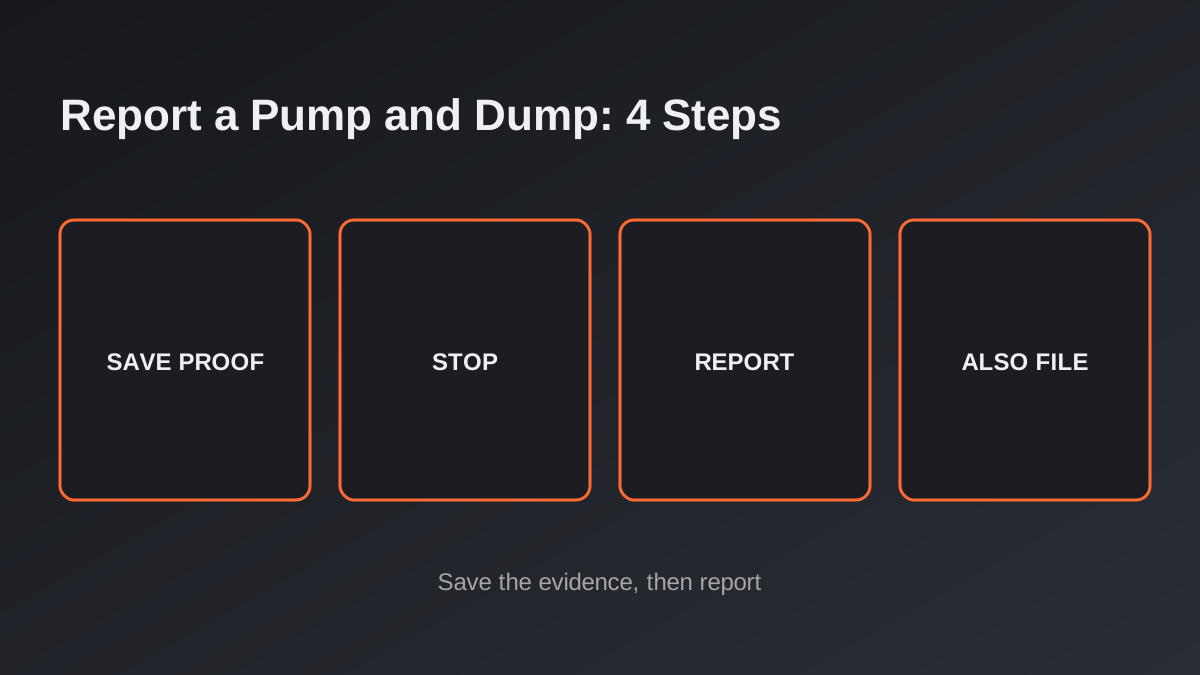
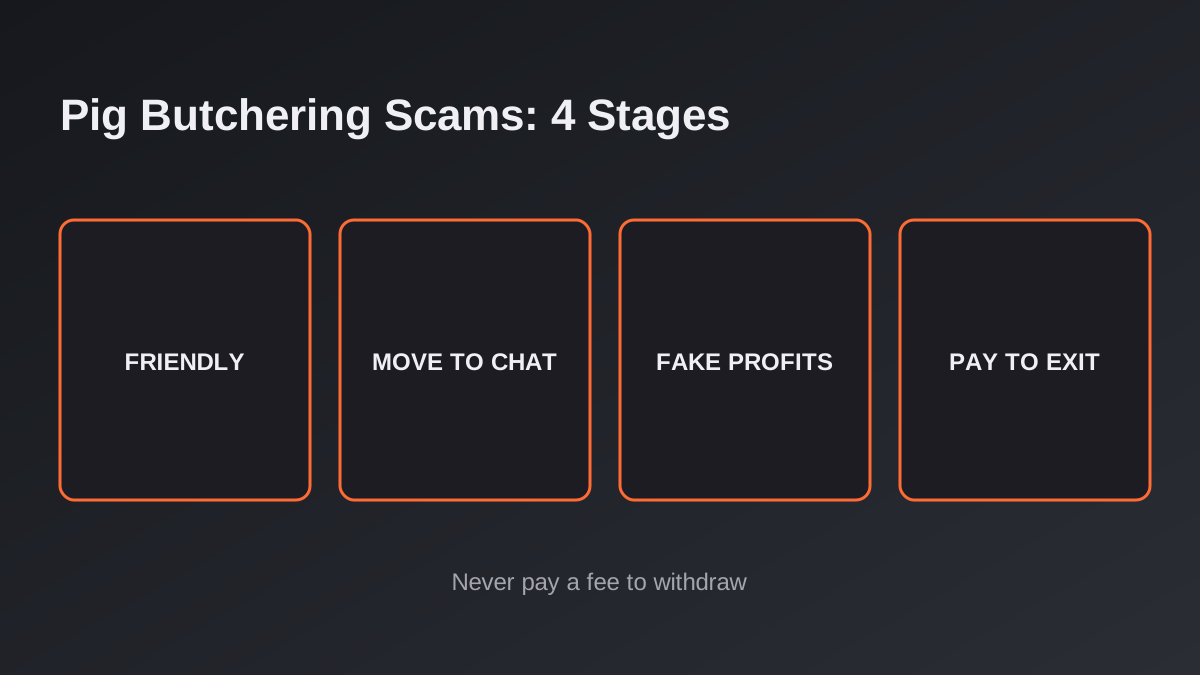
These often begin with an ad, a group chat or a friendly message, then move to a trading app that shows fake profits. For the full pattern, including how the fake dashboards work, see our explainer on pig-butchering and crypto investment fraud. If a "stock tip" group is involved, our guide to reporting a pump and dump covers the SEC and FINRA channels, and our comparison of a Ponzi scheme and a pyramid scheme explains the other common structure behind "guaranteed returns".
3. Romance and "family emergency" scams
Romance scams build trust over weeks or months before asking for money; family-emergency scams do the opposite and rely on panic. A caller who sounds like a grandchild says they are in trouble and begs you not to tell anyone. AI voice cloning has made this harder to dismiss, which is why we cover it separately in our guide to deepfake and voice-clone scams.
4. Prize, sweepstakes and lottery scams
You are told you have won, but must first pay a fee, taxes or "shipping". A real prize never requires payment up front.
Warning signs that apply to almost every scam
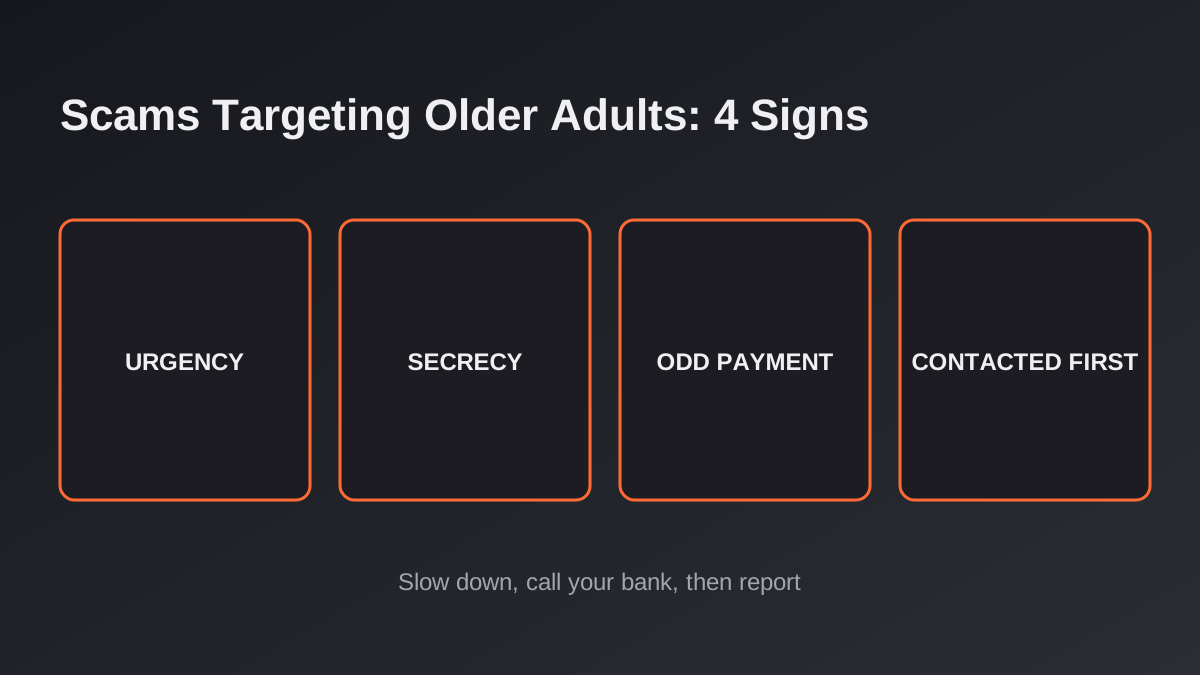
Different scripts, same mechanics. If two or more of these appear, stop and slow down:
- Urgency. You must act now, today, before the account is frozen or the offer ends.
- Secrecy. You are told not to tell your bank, your family or the police. The FTC notes that keeping you on the phone is itself a tactic, because it stops you talking to anyone who could see through the story.
- An unusual way to pay. Cryptocurrency, a Bitcoin ATM, gift cards, a wire transfer, or cash handed to a courier.
- You were contacted first. An unexpected call, text, pop-up or social media message.
- A promise of safety or guaranteed profit. Either "move your money to a safe account" or returns with no risk.
A simple family routine that works
Agree on a few rules before anything happens, ideally at an ordinary family meal rather than after a scare:
- Hang up and call back on a number you already trust. Use the number on the back of your bank card or on the company's official site, never a number the caller or a pop-up gave you.
- Make "no" and "let me ask someone" normal. A genuine bank or agency will wait while you check.
- Never move money to a "safe account", Bitcoin ATM or courier because someone you have not met in person told you to.
- Pick a family code word for emergency calls from relatives, so a cloned voice cannot pass the test.
- Tell one trusted person about any large transfer before you make it.
If money has already gone: the first hour
- Call your bank or card issuer immediately using the number on your card. Ask whether the payment can be stopped or recalled; the sooner they know, the better the chance.
- Stop all contact and all payments to the scammer. Do not pay anyone who offers to "recover" your money for a fee: recovery scams target people who have already lost money.
- Save evidence: screenshots, phone numbers, account or wallet details, emails and texts, and a note of the date, amount and payment method. Do not delete the chat.
- Secure your accounts. If you gave out passwords or let someone control your computer, change passwords from a clean device and contact your bank about the account. If your Social Security number was exposed, the FTC's identity-theft site, IdentityTheft.gov, lays out the next steps.
- Report it (below). A report matters even if you do not expect the money back.
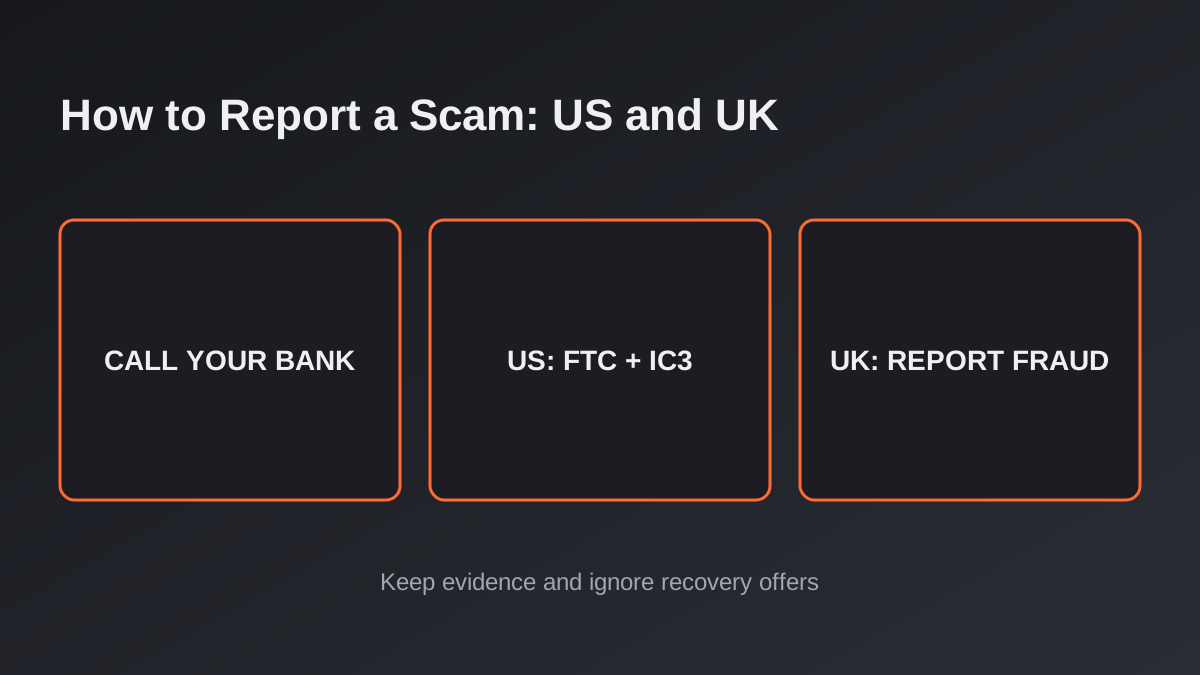
The FTC's page What To Do if You Were Scammed has step-by-step advice by payment method. For a wider walkthrough of every channel, see How to Report a Scam in the US and UK.
Where to report
- United States, FTC: ReportFraud.ftc.gov for any scam, including ones where you lost nothing.
- United States, FBI IC3: ic3.gov for scams that happened online or through crypto.
- United States, National Elder Fraud Hotline: 833-FRAUD-11 (833-372-8311), run by the Department of Justice's Office for Victims of Crime for people aged 60 or older and those helping them. Its case managers help victims with reporting and next steps. The FTC says it refers older adults with significant losses to this hotline.
- United Kingdom: Report Fraud at reportfraud.police.uk or 0300 123 2040 for England, Wales and Northern Ireland; in Scotland, call Police Scotland on 101. Tell your bank first.
- Canada: your local police and the Canadian Anti-Fraud Centre at 1-888-495-8501.
- Australia: Scamwatch, run by the ACCC.
If a scam involved a company or person you believe is committing fraud on a larger scale, official reward and tip programmes exist; our guide to the DOJ fraud whistleblower program explains how they work.
FAQ
Why are older adults targeted?
Scammers go where the money is and where trust is easiest to exploit. The FTC's data show older adults are more likely to report certain scam types, such as tech support and government impersonation, and to report very large losses. That reflects how these scripts are aimed, not any lack of intelligence on the victim's part. Anyone can be fooled by a well-run script.
Is it worth reporting if I did not lose money?
Yes. The FTC's data show older adults file no-loss reports at much higher rates than younger adults, and those reports help agencies see which scripts are circulating.
Can I get my money back?
Sometimes, especially if you contact your bank quickly or paid by card. Outcomes depend on how you paid: cards and some bank transfers have recall or dispute options, while cryptocurrency and gift cards are much harder to reverse. Nobody should promise you a refund for a fee.
What if I think my parent is being scammed right now?
Stay calm and do not shame them; scammers often rely on embarrassment and secrecy. Ask what they were told to do, help them call their bank on a trusted number, and, if they are 60 or older, call the National Elder Fraud Hotline together.
Sources
- FTC press release: FTC Issues Annual Report to Congress on Agency's Actions to Protect Older Adults (19 October 2026), and the report Protecting Older Consumers 2025-2026
- FTC Data Spotlight: False alarm, real scam: how scammers are stealing older adults' life savings (7 August 2025)
- FTC consumer advice: What To Do if You Were Scammed; ReportFraud.ftc.gov
- US Department of Justice, Office for Victims of Crime: National Elder Fraud Hotline
- FBI: Internet Crime Complaint Center (IC3)
- UK: Report Fraud (City of London Police); Canada: Canadian Anti-Fraud Centre; Australia: Scamwatch (ACCC) (all checked 31 October 2026)
This article is general consumer-awareness information, not legal or financial advice. Figures are as reported by the agencies cited; check the official sites above before you act.