How to Check a Financial Advisor or Investment Before Paying
On this page
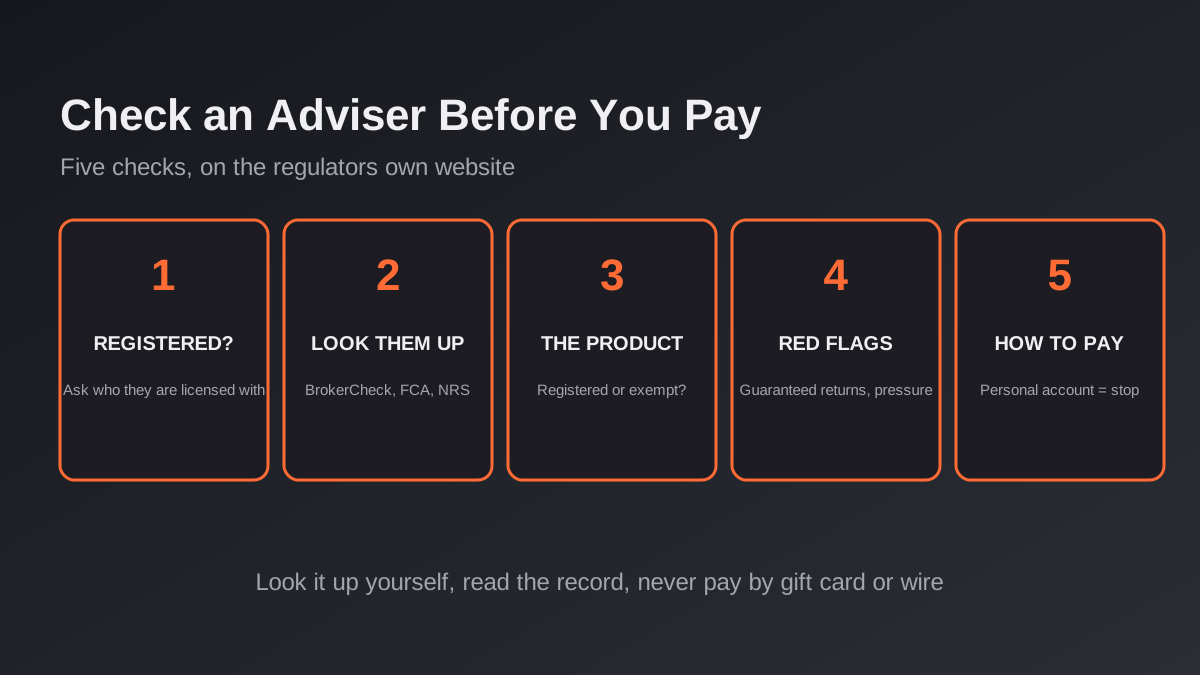
The short answer: before you send money to any adviser, broker or trading platform, check five things yourself. Is the person or firm registered with a regulator? What does their official record say? Is the investment itself registered or properly exempt? Does the pitch match known fraud red flags? And how are you being asked to pay? Do the lookup on the regulator's own website, typed into your browser, never through a link, phone number or "verification" page supplied by the seller.
The topic is timely. On 3 November 2026 Europol and Eurojust announced the seizure of more than 100 servers in an action against an alleged investment fraud network. Authorities say potential victims live in at least 50 countries and estimate losses at over €4 million. According to Eurojust's account, victims were told that cryptocurrency, currency and stock trading would bring enormous profits quickly. After a small first transfer they were shown inflated profits that made the platform look real, then pressured to invest much larger sums. When they tried to withdraw, they met one stalling tactic after another, and eventually the perpetrators disappeared (Help Net Security). Seven suspects were arrested for surrender or extradition to Germany; they have not been convicted of anything, and we make no claim about any individual. The pattern, though, is a useful reminder: a professional-looking dashboard proves nothing about whether your money exists.
This is a general awareness guide based on the official sources listed at the end. It is not legal or financial advice, and a clean record is not a guarantee. Rules differ by country and state.
Check 1: Is the seller registered or licensed?
Start with a plain question: "Who are you registered or licensed with, and in what capacity?" FINRA, the US industry regulator for broker-dealers, says legitimate investment professionals, including registered representatives, investment advisers and insurance agents, must be registered or licensed with FINRA, the Securities and Exchange Commission (SEC) and/or the state securities or insurance regulator before they can sell you anything. Its advice if the answer is no is blunt: say goodbye and do not buy (FINRA: Check Registration).
The SEC's investor education site adds that unlicensed, unregistered persons commit much of the investment fraud in the United States, so it is worth checking the background of any financial professional to make sure the person is licensed (Investor.gov).
Check 2: Look them up, then read the record
Do not take their word for it, even if they say yes. Use the official databases yourself:
- United States: search the person and the firm on FINRA BrokerCheck or call the BrokerCheck Help Line at (800) 289-9999. Investment advisers who are not registered with FINRA can still be looked up there, and if they are registered with the SEC the profile directs you to the SEC's Investment Adviser Public Disclosure (IAPD) database. The summary report shows employment history, qualifications and disclosure events. FINRA also suggests contacting your state securities regulator and using the SEC's Action Lookup Tool to find people against whom the SEC has taken formal action.
- United Kingdom: use the FCA Firm Checker. The FCA says almost all UK financial services firms must be authorised or registered, and tells you to check that the firm reference number (FRN) and contact details you were given match the Firm Checker. If there are no contact details listed, or the firm says they are out of date, call the FCA on 0800 111 6768 (FCA ScamSmart).
- Canada: use the National Registration Search run by the Canadian Securities Administrators (CSA), then check the CSA Disciplined List and Cease Trade Orders Database on SEDAR+ for disciplinary decisions (CSA: Are They Registered?).
Read the whole record, not just the word "registered". Look at the disclosure or disciplinary section, the firm they work for, and whether the address and phone number on the official record match what you were given.
Beware of impersonation
FINRA warns that some bad actors falsely claim to be registered and may even provide doctored information from seemingly reputable sources such as BrokerCheck. Others misuse the name of a real registered professional or firm to look legitimate. That is why you search independently and look for inconsistencies between what they tell you and what you find. The FCA gives the same instruction for the UK: always use the contact details on the Firm Checker, because some firms pretend to be authorised firms.
Check 3: Is the investment itself registered?
A trustworthy seller can still offer a poor product, and a fake seller can describe a product that does not exist. FINRA's questions for the investment are:
- Ask: "Is this investment registered with the SEC?" If not, ask why. Not every offering has to be registered. Government securities are exempt, and the SEC provides exemptions for certain intrastate offerings and small public and private offerings under Regulation D. FINRA also notes that most crypto assets are not registered. Unregistered generally means more risk.
- Check it yourself. The SEC's EDGAR database holds registration statements, prospectuses and annual financial reports for public companies. If an exemption is claimed, you should be able to find that information as well.
Two caveats from FINRA: SEC registration does not guarantee an investment will be good or immune to fraud, and lack of registration does not automatically mean it is illegitimate. The point is risk. If you can find little or no public information, or the investment is not being sold through a registered financial institution, FINRA advises being especially wary.
Check 4: Compare the pitch with the red flags
The SEC's checklist of investment fraud red flags is short enough to keep on your phone (Investor.gov):
- unlicensed investment professionals
- aggressive sellers who may provide exaggerated or false credentials
- offers that sound "too good to be true"
- "risk-free" investment opportunities
- promises of great wealth and guaranteed returns
- "everyone is buying it" pitches
- pressure to invest right now
- over-the-top, sensational pitches that may have fake testimonials
- unsolicited pitches seeking to obtain your personal information
- being asked to pay by credit card, gift card, or wiring money abroad or to a personal account
The FCA's own list of warning signs overlaps. It asks whether the contact was unexpected, whether you feel pressured to act quickly, whether the offer sounds too good to be true, whether it is exclusively for you or should be kept secret, whether they are flattering you, and whether they speak with authority and claim to be authorised. A "yes" to any of these means stop and check.
Check 5: How are you being asked to pay?
This is the check people skip because the earlier ones looked fine. The SEC lists payment by credit card, gift card, or wire abroad or to a personal account as a red flag. A real firm will normally take your money into a regulated account in the firm's own name, not into someone's personal account or an unfamiliar overseas bank. If the instructions change midway, or you are asked to move to a different platform, treat that as a reason to pause, not a technicality.
The fake-platform pattern in the Europol case is worth memorising: a small first deposit, a dashboard showing gains, pressure to add larger sums, then delays when you ask to withdraw. If a platform asks for a fee, a tax payment or a "verification deposit" before it will release your money, that is the moment to stop paying. Do not pay a "recovery" firm either: the FCA lists recovery room scams among common investment scams.
Registered does not mean right for you
The CSA makes a point that applies everywhere: just because an individual or firm is registered does not mean the investment is a good fit for you. Advisers offer different services and charge different fees, so ask how they are paid and get answers in writing. In the UK, the FCA suggests considering independent financial advice before a big decision and points to MoneyHelper for finding an adviser.
If you have already paid
- Stop sending money. Do not pay any fee to "unlock" a withdrawal.
- Save evidence. Screenshots of the platform, chats, emails, wallet addresses, bank details, dates and amounts.
- Call your bank or card issuer using the number on your card, and ask about stopping or disputing the payment.
- Report it. Investor.gov says to contact the SEC, FINRA or your state securities regulator if you have a question about an investment or think you have encountered fraud. FINRA also runs a Securities Helpline for Seniors on 844-574-3577 (Monday to Friday, 9am to 5pm ET). Then file with the FTC and the FBI's IC3, or the UK and Canadian bodies.
Our guide to how to report a scam in the US and UK covers each agency in detail.
Where this fits with other scams
If the contact started as a chat from a stranger that drifted into crypto, read how pig butchering scams work. If the promise is paying early investors from newer money, see Ponzi scheme vs pyramid scheme. For stock tips pushed in group chats, our guide to reporting a pump and dump explains the evidence to save. Older relatives are targeted heavily, so share scams targeting older adults with them too.
Frequently asked questions
How do I check if a financial advisor is legitimate?
Search their name and firm on the regulator's own database: BrokerCheck or the SEC's IAPD in the US, the FCA Firm Checker in the UK, or the National Registration Search in Canada. Read the disclosure history and confirm the contact details match what you were given.
Is a registered adviser always safe?
No. Registration means the person or firm met regulatory requirements, and the record shows any disciplinary history. The CSA notes registration does not mean the investment is a good fit for you, and FINRA warns that scammers sometimes impersonate real registered professionals.
Does SEC registration mean an investment is safe?
No. FINRA says SEC registration does not guarantee an investment will be good or immune to fraud. It does bring disclosure of financial information that helps you judge the product.
What if I cannot find the adviser or platform on any register?
Treat that as a warning. FINRA's advice for an adviser who says they are not registered or licensed is to say goodbye and not buy. Unregistered does not automatically mean illegal for every product, but it means you carry more risk and have fewer routes for complaint or recovery.
Sources
- FINRA: Check Registration: Sellers and Investments and BrokerCheck (checked 8 November 2026)
- SEC Investor.gov: Check Out Your Investment Professional, Red Flags of Investment Fraud Checklist and How to Avoid Fraud
- Financial Conduct Authority: Protect yourself from scams (last updated 19 January 2026)
- Canadian Securities Administrators: Are They Registered?
- Help Net Security, 3 November 2026: Police seize over 100 servers linked to investment fraud with more than €4 million in losses (reporting Europol and Eurojust statements)
General awareness information, not legal or financial advice. Laws, registers and phone numbers change and vary by state and country; confirm with the regulator or a qualified adviser before you act.