Apple Pay and Apple Cash Scams: How to Report Them

On this page
The short answer: how you report an Apple Pay scam depends on which money was used. If you paid or sent money with Apple Cash (US only), contact an Apple Cash Specialist at Green Dot Bank, the bank that provides Apple Cash. If a card in your Wallet was charged, call the card issuer and dispute the charge. In both cases, file a report with the FTC at ReportFraud.ftc.gov as well. Do it quickly: the window to reverse a payment is shortest in the first hours, and reporting costs nothing even when recovery is unlikely.
The topic is timely. On 4 November 2026 Malwarebytes described a fake page promising a "$750 Apple Cash reward" after a "device verification". There is no reward, the "eligibility check" is a timer that passes everyone in seconds, and the page pushes visitors to install an app and play games through affiliate tracking links (Malwarebytes). The same write-up notes that Green Dot Bank will require some users to verify their identity before reloading Apple Cash from 9 November, which gives fake "verify your account" messages extra cover. We could not independently confirm that notice, so treat any verification request that arrives by text or link as suspect and check inside Wallet instead.
This is a general awareness guide based on the official sources listed at the end. It is not legal or financial advice. Rules differ by bank, card and country; confirm details with your provider.
Apple Pay and Apple Cash are not the same thing
People say "Apple Pay scam" for two quite different situations, and the difference decides who you call.
- Apple Pay with a card. Apple Pay is the way you pay with a debit or credit card stored in Wallet. The money moves on your card, so your card issuer is the party that can dispute a charge.
- Apple Cash. Apple Cash is a separate balance you can send, receive and spend through Wallet. Apple says Apple Cash services are provided by Green Dot Bank, Member FDIC, with Apple Payments Services LLC acting as a service provider. It is available only in the 50 US states, the District of Columbia and Puerto Rico, and you must be 18 or older and a US resident (Apple Support). Neither Apple Inc. nor Apple Payments Services LLC is a bank.
Scams usually involve a person talking you into sending money, not a hack of Apple Pay itself. Apple's own guidance is that you should send and receive Apple Cash only with people you know and trust.
What to do in the first hour
- Stop all contact and payments. Do not send "just one more" payment to fix the problem, and do not follow instructions from anyone who contacted you first.
- Secure your Apple Account if you shared anything. If you gave out your password, a verification code or typed details into a fake page, change your Apple Account password immediately and make sure two-factor authentication is on (Apple Support). Apple says it will never ask you for your password, verification codes or device passcode.
- Collect evidence. Screenshot the messages, phone numbers, usernames, amounts, dates and the payment confirmation. Do not delete the conversation.
- Call the right party for the money. Use the routes below. Use the number printed on the back of your card or on the provider's real website, never a number the scammer gave you.
- Report to the authorities. This is separate from getting a refund and helps investigators spot patterns.
Who to report to
- Apple Cash payment you sent or were tricked into authorising: Apple says that if you believe you experienced a scam you should contact an Apple Cash Specialist at Green Dot Bank (Apple Support).
- Card charge through Apple Pay: contact the card issuer and dispute the charge. The FTC advises that if you paid with a credit or debit card you should try disputing the charge right away (ReportFraud.ftc.gov FAQ).
- Money pulled from, or sent out of, your bank account: call your bank at once. The FTC's advice for an electronic bank transfer is to contact your bank immediately.
- The FTC: report at ReportFraud.ftc.gov. You can report even if you did not lose money. Outside the US, the FTC points people to econsumer.gov.
- FBI IC3: for internet-enabled fraud with a financial loss, file at ic3.gov.
- Apple itself, for the scam message: forward a suspicious email that claims to be from Apple to reportphishing@apple.com. For a suspicious text, screenshot it and email the screenshot to the same address. For a suspicious FaceTime call or link, email a screenshot to reportfacetimefraud@apple.com (Apple Support).
For the full reporting routes in the US and UK, including what each agency does with a report, see our guide to how to report a scam.
Can you get your money back?
Sometimes, and it depends on how the money left your account. Be wary of anyone who guarantees a refund.
If the payment was unauthorised
The Consumer Financial Protection Bureau (CFPB) says person-to-person payments that meet the legal definition of an electronic fund transfer are covered by the Electronic Fund Transfer Act and Regulation E. It also says that when a fraudster uses account access details obtained through "fraudulent inducement", such as a caller pretending to be your bank who tricks you into handing over login details or a texted code, the resulting transfer is treated as an unauthorised transfer. Providers that hold your account have error-resolution duties once you notify them (CFPB Electronic Fund Transfers FAQs). In practice, that makes fast, written notice to your bank and card issuer worth doing.
If you sent the money yourself
This is the hard case, and it is the most common one. Apple warns that if you pay someone with Apple Cash for something you have not received, you might not be able to get your money back, and that paying a marketplace seller outside the marketplace adds risk. The CFPB guidance above deals with transfers a fraudster initiates using your credentials; it does not promise refunds when you knowingly sent a payment to someone who then turned out to be dishonest. Still report it: the provider may be able to act on the recipient's account, and your report feeds law enforcement data.
If a card was charged
A disputed card charge goes through the card issuer's process, which is why the FTC recommends disputing quickly. Ask the issuer to block the card and issue a new one if card details were shared.
Apple-themed scams to recognise
- Fake rewards and "verify your device" pages. Apple lists fake promotions offering free products and prizes among common tricks (Apple Support). Real rewards never require you to install an app first.
- "Apple Support" asking you to test your phone with a payment. Apple says a scammer posing as Apple or tech support might ask you to install screen-sharing software or to send an Apple Cash payment, and that Apple will not request payment via Apple Cash.
- "Bank" or "government" callers demanding payment. Apple says businesses and agencies, such as the IRS, will not request Apple Cash payments. Hang up and call the organisation's published number. A bank's number is on the back of your card.
- A check for more than the price. Apple warns scammers may offer a check and ask for an Apple Cash payment, and the check can bounce after you have paid.
- Gift cards as payment. Apple says you should not buy gift cards and give out the codes as a form of payment, and never use Apple Gift Cards to pay other people.
- Pressure to act now. Apple's advice is to consider not paying if someone is pressuring you or if you would not hand that person physical cash.
If a stranger sends you money and then asks for it back, do not send it back yourself. That matches the overpayment pattern Apple describes with bounced checks, where the original payment can disappear later. Ask the Apple Cash Specialist at Green Dot Bank what to do first.
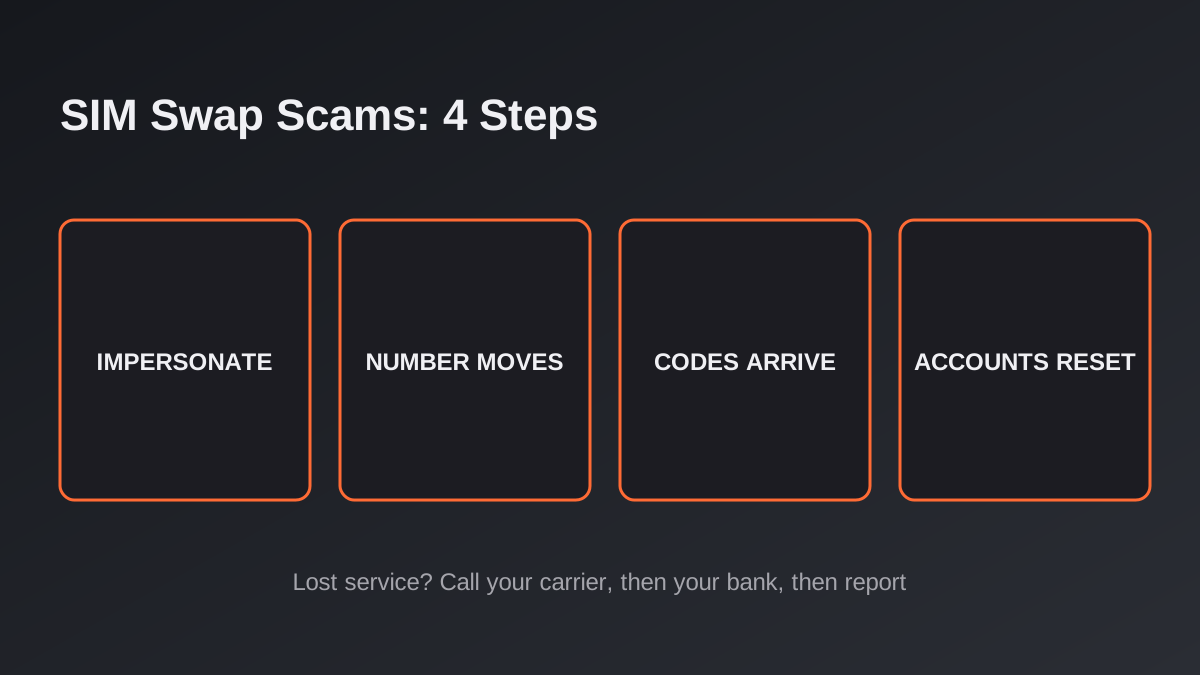
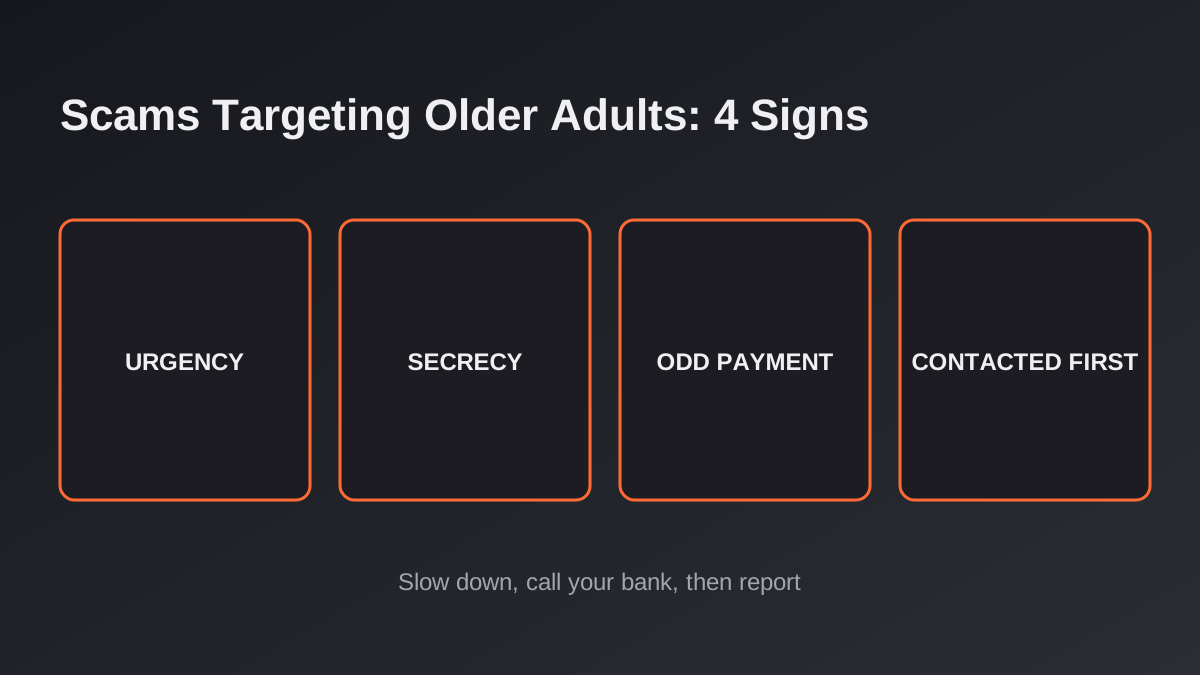
Several of these scripts overlap with other fraud types we have covered, including SIM swap scams that target the phone number behind your accounts and scams targeting older adults. If the contact began with a "wrong number" chat that turned into an investment pitch, read about pig butchering scams.
Outside the United States
Apple Cash is a US-only service, so readers elsewhere are usually dealing with a card paid through Apple Pay, a bank transfer or another app. The first call is still your card issuer or bank. Then report to your national body: Report Fraud in the UK, the Canadian Anti-Fraud Centre in Canada, or Scamwatch in Australia. Our US and UK reporting guide has the details.
Frequently asked questions
Is Apple Pay itself unsafe?
The scams described here rely on convincing you to send money or share account details, not on breaking Apple Pay. Apple says Apple Cash uses security features built into the hardware and software of your device, and warns you before you send money to someone outside your contacts or when a transaction looks risky. Pay attention to those warnings.
Does Apple refund Apple Cash scams?
Apple's support page does not promise refunds. It directs people who believe they were scammed to an Apple Cash Specialist at Green Dot Bank, and warns that payments for items you never received might not be recoverable.
Do I need a police report first?
You can start with your provider and with ReportFraud.ftc.gov straight away. Your bank may ask for details of what happened, so keep your screenshots and a timeline.
What if I only clicked a link and paid nothing?
Close the page, do not install anything it asked for, and delete the message. If you entered a password or code, change your Apple Account password and check two-factor authentication. You can still report the message to Apple and the FTC.
Sources
- Apple Support: Avoid scams when you use Apple Cash and Recognize and avoid social engineering schemes (both checked 5 November 2026)
- Federal Trade Commission: ReportFraud.ftc.gov FAQ
- Consumer Financial Protection Bureau: Electronic Fund Transfers FAQs (Regulation E compliance aid)
- FBI: Internet Crime Complaint Center
- Malwarebytes, 4 November 2026: The fake $750 Apple Cash reward that pays out nothing
General awareness information, not legal or financial advice. Laws, bank policies and deadlines change and vary by state and country; confirm with your provider or a qualified adviser before you act.