The Fraud Triangle: Why Accounting Fraud Happens and the Red Flags to Watch
On this page
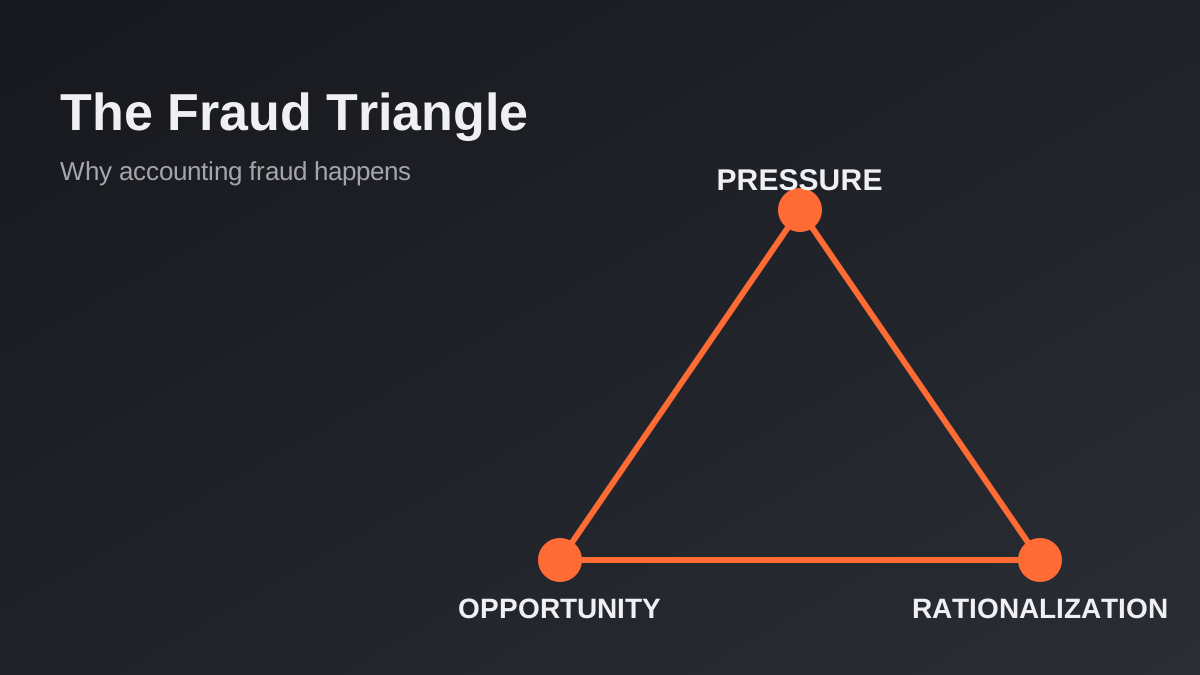
The short answer: the fraud triangle says accounting fraud tends to happen when three things line up: pressure to hit a number, a weak spot in the controls that creates an opportunity, and a way for the person involved to justify it to themselves. It is a way to spot risk, not proof that anyone has done anything wrong. For investors, employees and ordinary readers it turns a vague worry ("these numbers look too good") into three concrete questions you can ask.
The topic is timely. On 10 November 2026 the US Securities and Exchange Commission published its enforcement results for the fiscal year that ended on 30 September. It reported 348 enforcement actions, including 235 standalone cases, and said the Division of Enforcement is focused on fraud, market manipulation, insider trading, gatekeeper failures and "violations that compromise the integrity of disclosures and financial reporting". It also said two-thirds of standalone actions included charges against at least one individual, and that it returned about $731 million to more than 250,000 harmed investors (SEC press release 2026-113). Those are the regulator's own figures; they describe cases filed, not a measure of how much fraud exists.
This is a general awareness guide based on the official sources listed at the end. It is not legal, audit or investment advice. Allegations in any case mentioned here are allegations until a court decides otherwise, and we make no claim about any individual.
What the fraud triangle actually is
The idea is usually credited to the criminologist Donald Cressey, who studied people convicted of embezzlement in the 1950s. Auditing standards later adopted the same three-part logic. The US audit regulator, the Public Company Accounting Oversight Board (PCAOB), puts it this way in its standard on fraud in a financial statement audit (AS 2401, paragraph .07): three conditions generally are present when fraud occurs.
- Incentive or pressure. Management or other employees have a reason to commit fraud.
- Opportunity. Circumstances such as missing controls, ineffective controls or the ability of management to override controls make a fraud possible.
- Rationalization and attitude. Those involved can justify the act to themselves. The PCAOB adds that some people have an attitude or set of values that lets them act dishonestly knowingly, but that "even otherwise honest individuals can commit fraud in an environment that imposes sufficient pressure on them".
The same paragraph makes a point worth remembering: the greater the incentive or pressure, the more likely an individual will be able to rationalize the acceptability of committing fraud. That is why the triangle is a risk model. It tells you where to look, not who is guilty.
Side one: pressure
Pressure is the easiest side to see from the outside, because it is often public. Examples of the kinds of pressure that raise risk include:
- a company that has guided the market to a growth number and has little room to miss it
- bonuses, stock awards or loan covenants tied to one reported figure
- a struggling business that needs to look healthy to raise money or keep a credit line
- personal financial stress on someone who has access to cash or records
Pressure alone is not a red flag. Almost every company has targets. It matters when it combines with the other two sides.
Side two: opportunity
Opportunity is about the environment. The PCAOB notes that fraudulent financial reporting often involves management override of controls that otherwise may appear to be operating effectively, and that management is in a unique position to manipulate accounting records. It also explains that fraud can be concealed through falsified documents, withheld evidence or collusion with employees or third parties. In its own words, even a properly planned audit cannot provide absolute assurance that fraud will be detected.
Signs that opportunity may be wide open include one person controlling both a process and the records of it, thin oversight from a board or audit committee, complex transactions few people understand, and a culture where questions are unwelcome. The PCAOB says management and those who oversee reporting should set the proper tone, create a culture of honesty and high ethical standards, and put in place controls to prevent, deter and detect fraud. When they do, it says, opportunities to commit fraud can be reduced significantly.
Side three: rationalization
This is the side you almost never see directly, but the PCAOB describes how it sounds. Fraudulent financial reporting need not be the result of a grand plan or conspiracy. Managers may rationalize a misstatement as an aggressive rather than indefensible reading of complex accounting rules, or as a temporary misstatement expected to be corrected later when results improve. "We will fix it next quarter" is the classic version.
A real-world pattern: when the paperwork is the lie
Accounting fraud is not limited to inflated revenue. On 29 October 2026 the SEC charged two entities, BG Wealth Sharing Ltd and DSJ Exchange Pty Ltd, in a scheme it alleges raised more than $130 million from tens of thousands of retail investors. According to the SEC's complaint, the defendants promised extraordinary, risk-free returns, claimed to be registered with the SEC, and submitted false Form ADV and Form D filings that were publicly viewable and shown to investors as supposed proof of approval. An SEC enforcement official described fake certificates bearing the SEC's seal and periodic payments to some investors, a Ponzi-like tactic, while the remaining funds were allegedly misappropriated. The defendants are alleged to have used social media, encrypted messaging, weekly video calls and a mobile app to keep investors engaged (SEC press release 2026-110). The SEC has said the filings were removed from its website.
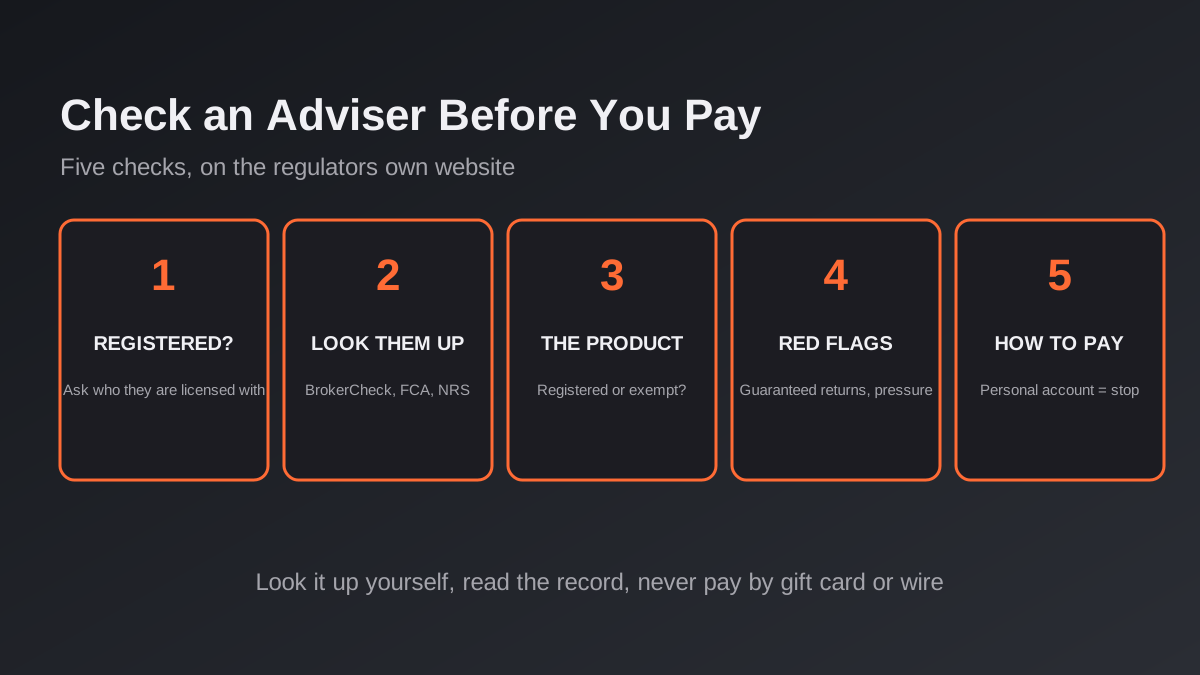
Read through the triangle: the pressure was the need to keep new money flowing, the opportunity was that anyone can file certain forms and a filing on a government site looks like approval, and the rationalization is for a court to examine. The lesson for readers is practical. A document that exists on an official website is not the same as an official endorsement. The SEC encourages investors to check the background of anyone offering them an investment on Investor.gov. Our guide to checking a financial advisor or investment before paying walks through those checks.
Red flags to watch for, by role
If you are an investor
- Results that are smooth and always just above expectations while cash flow tells a different story
- Frequent changes of auditor, late filings or restatements without a clear explanation
- Explanations that grow more complicated each time you ask
- Promises of risk-free or guaranteed returns, which the SEC treats as a classic red flag of investment fraud
If you are an employee or manager
- A request to book a transaction in a way that does not match what happened
- Pressure to close a period "clean" or to move a cost to next quarter
- Colleagues who never take leave, or who resist anyone else looking at their records
- Approvals done in a rush, or by email after the event
If you run a small business
- Separate who approves payments from who records them, and who reconciles the bank account
- Review bank statements yourself, not just the summary someone prepares for you
- Keep a clear path for staff to raise concerns without fear
What to do if you suspect accounting fraud
- Write down what you saw. Dates, documents, who said what. Do not copy confidential files you are not entitled to take; ask a lawyer about the safest way to preserve evidence.
- Use the proper channel. Inside a company, that may be the audit committee or an ethics line. For public companies in the US, you can submit a tip to the SEC through its online tips, complaints and referrals system.
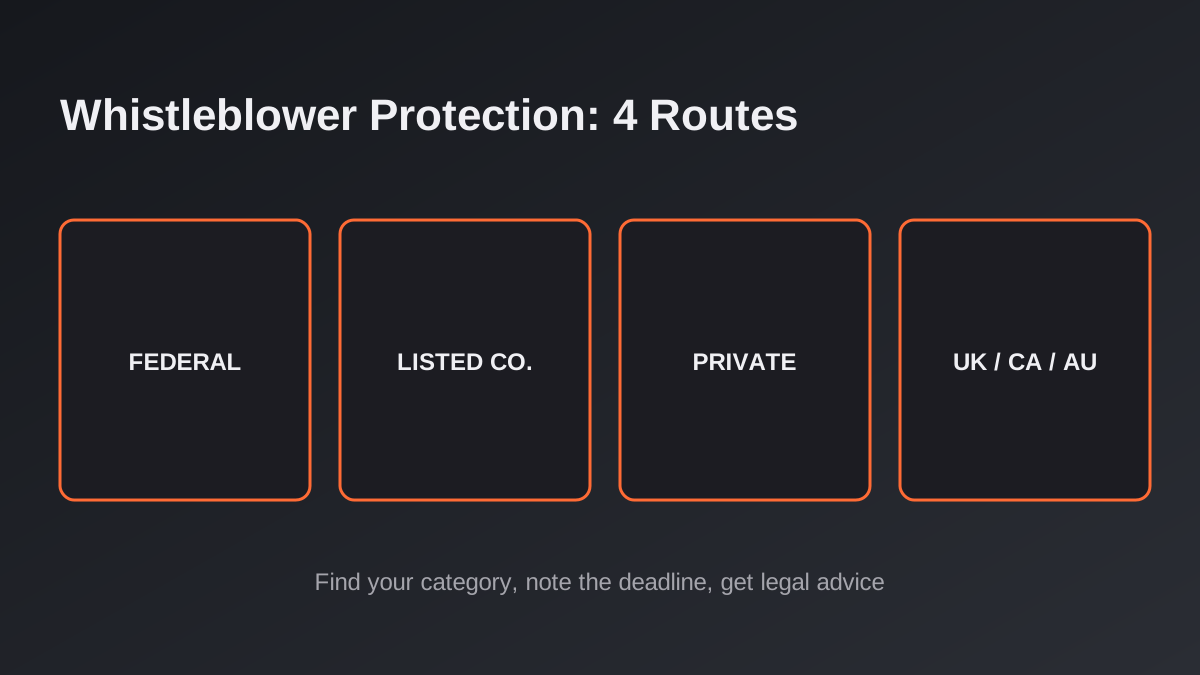
- Know your protections. Whistleblower rules are complicated and deadlines matter. See our guides to the Whistleblower Protection Act and the fraud whistleblower incentive program, and speak to an employment lawyer before you act.
- If you lost money as a consumer or investor, report it to the FTC at ReportFraud.ftc.gov, the FBI's Internet Crime Complaint Center (IC3), and the SEC or your state securities regulator. UK readers can report through Report Fraud and tell the Financial Conduct Authority about firms they suspect. Our guide on how to report a scam in the US and UK lists each agency.
Auditors are one line of defence, not the only one. For how auditors stay independent from the companies they check, read what is auditor independence, and for stock tips that fall apart, see how to report a pump and dump.
Frequently asked questions
What is the fraud triangle in simple terms?
It is a model that says fraud tends to occur when three conditions are present together: pressure or incentive, opportunity (weak or overridden controls) and rationalization (a way to justify the act). The PCAOB describes these three conditions in AS 2401.
Does the fraud triangle prove someone committed fraud?
No. It identifies conditions that raise risk. Pressure, opportunity and rationalization exist in many organisations where no fraud happens. Only a court or regulator can decide whether fraud occurred.
Who came up with the fraud triangle?
The concept is generally credited to Donald Cressey, a criminologist who interviewed people convicted of embezzlement. Auditing standards, including the PCAOB's, use the same three elements.
Can auditors catch every accounting fraud?
No. The PCAOB states that absolute assurance is not attainable, and that fraud may be concealed through falsified documents, withheld evidence or collusion. Auditors are expected to plan and perform the audit to obtain reasonable assurance and to apply professional skepticism.
Where do I report suspected accounting fraud at a US public company?
You can submit a tip to the SEC through its online tips, complaints and referrals system. Employees may also use internal reporting channels such as an audit committee or ethics hotline, and should seek legal advice about whistleblower protections first.
Sources
- SEC: SEC Announces Enforcement Annual Results for Fiscal Year 2026, 10 November 2026 (checked 12 November 2026)
- SEC: Two Entities Charged in $130 Million Fraud Scheme That Used False SEC Filings to Boost Investor Confidence, 29 October 2026
- PCAOB: AS 2401: Consideration of Fraud in a Financial Statement Audit (paragraphs .04 to .13)
- SEC Investor.gov: Red Flags of Investment Fraud Checklist
General awareness information, not legal, audit or financial advice. Laws, agency procedures and deadlines change and vary by country and state; confirm with the relevant regulator or a qualified professional before you act.